
By Kristy Henderson
The father of India’s ‘Green Revolution’, Professor MS Swaminathan, delivered a lecture at Melbourne University on Monday night on how to feed the world’s poor in perpetuity. The evergreen revolution, as he calls this challenge, must be able to produce more, using less – less land, less water, less fertilizer.
Professor Swaminathan claims to be pro-woman, pro-nature and pro-poor. The conservation of biodiversity, maintaining soil fertility, increasing the climate resilience of food crops, combined with better, and more, education and technological innovation are the keys to his ever green revolution.
Professor Swaminathan argues that people should be born for happiness, not just existence, and as the world’s population balloons to 7 billion this sentiment forms the philosophical basis for his resolve to end world hunger.
To this end, Professor Swaminathan stressed the need for increased research into organic agriculture, and the the importance of respect for the ‘the web of life’, and the biological diversity it supports, in order to maintain human food supply beyond the needs of the current generation. He also expressed support for increased interdisciplinary education based on both theoretical training and practical experience. Yet Professor Swaminathan remains wedded to the idea that the answer to solving world poverty lies in producing more, rather than in improving current systems of distribution and supply.
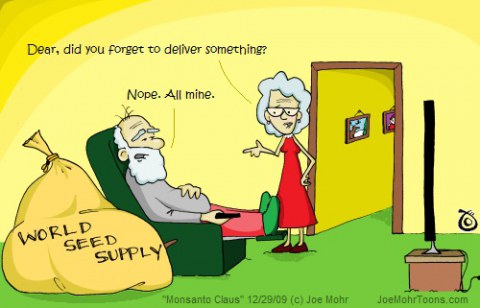
Vandana Shiva, a well-known advocate of organics who established ‘Navdanya’, a women's seed-saving organisation, has thus been quoted as saying, “Dr. Swaminathan is both the green revolutionary with chemicals and the green revolutionary without chemicals!” Shiva argues that Indian farmers require seed security and land security in order to meet the food needs of India. Seed saving ensures that year after year farmers have a reliable source of seed that propagates, which companies such as Monsanto have prohibited through patenting laws and intellectual property rights. According to Shiva, patents increased the price of Bt cottonseed, leading to the suicide of over 200,000 farmers (Da Costa, 2009).
The UN rapporteur on the right to food, Jean Ziegler, has also argued that, ‘the world already produces enough food to feed every child, woman and man and could feed 12 billion people, or double the current world population’ (Ziegler, 2008). Statistics also show that despite the introduction of genetically modified crops in 1996, which Swaminathan supports if they are approved to be safe, the number of people starving has increased, rather than decreased (FAO, 2011).
The audience at Monday’s lecture was thus left grasping for the finer details of Swaminathan’s vision. He was notably silent on the debilitating affects of neo-liberal economic policies on Indian farmers, and skirted around the controversial impacts associated with the use of biotechnologies, such as genetically modified crops.
Professor Swaminathan’s claim that the aim of the ‘ever green revolution’ should be to produce more is suspect. Perhaps constraining the influence of greedy biotechnology and fossil fuel companies, and reducing the consumption patterns of the affluent, which, in the end, are driving climate change and associated environmental degradation patterns globally, should be the primary focus of the next 'green' revolution.
Professor Swaminathan is a panellist in the upcoming debate: ‘How do we Feed and Clothe the world in 2050’, to be compared by the ABC’s Fran Kelly on Wednesday 15th, 5:30pm -7:30pm. Reg: www.theccrspiconference.com.au
For more information on the dangers of genetically modified crops go to: www.geneethics.org
References:
Da Costa, A, 2009, ‘Vandana Shiva on Sustaining India’s Agriculture’, accessed on 15.02.2011 at http://www.worldchanging.com/archives/010152.html
Food and Agriculture Organisation of the United Nations (FAO), 2011,'Hunger statistics', accessed on 15.02.2011, http://www.fao.org/hunger/en/
Ziegler, J, 2008, ‘Promotion and Protection of All Human Rights, Civil, Political, Economic, Social and Cultural Rights, Including the Right to Development: Report of the Special Rapporteur on the right to food, Jean Ziegler’, to download from http://en.wikipedia.org/wiki/Hunger#cite_note-4, accessed on 15.02.2011
Comments
But what starts with its godfather sitting on the fence?
Is the man aware of the contradictions in his own position? When it comes to food, it should be most obvious that there is no such thing as endless growth. It is only the way to saturation. Of course the invisible factory farm animal overpopulation comes to mind and its significance for climate change, but also the fossil fuels pyramid scheme and its risk of human overpopulation. The key to this lies in the other green revolution, the project to tame the Islamic revolution into something which does not pollute societies with a permanent unholy inquisition.
Instead people want the world war to be ended with a due post-war tribunal and then live on in peace, and for this to happen the Persian knot must be undone without destroying the material. They would not be a mirror image of American totalitarianism in impatience, was it not for the historical sacrilege the so-called intelligence community had committed against them. A true resolution of this is in the interest of all of us, for as long as there is war over fuel some will burn food, and as long as this happens no green revolution ever can permanently succeed. End the oil wars, and there will be the condition of the possibility of justice.