
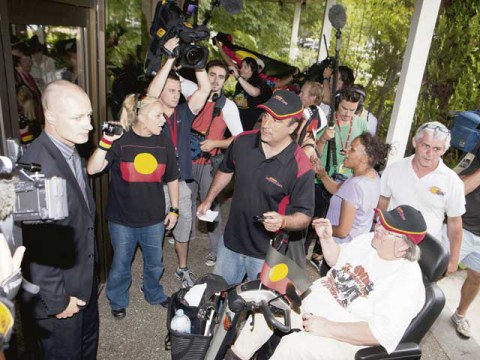
Published at Indymedia courtesy of the National Indigenous Times (12.12.2012) - Photo courtesy of the National Indigenous Times, by Geoff Bagnall; January 26, Lobby Restaurant
Article by Gerry Georgatos – National Indigenous Times award winning journalist, PhD researcher Deaths in Custody and social justice campaigner – recently he successfully campaigned for the release of scores of Indonesian children from Australian adult prisons, and has raised the funds in shipping thousands of children’s wheelchairs to war torn countries. He has written two Masters in trying to understand and find ways forward from the ugliness of racism, and his latest book to be released in January is Climate of Death: Justice denied means more will die.
I joined the National Indigenous Times 18 months ago, after a phone call from the newspaper’s editor, Stephen Hagan, in July 2011, and here we are as we quickly march into 2013. My journey with the National Indigenous Times has been an increasingly passionate one, as a result of the voluminous ability to look into one story after another I have had the opportunity to meet peoples who have been far removed from the myriad bright merit of what is right, from what should have been their due, and for whom justice has been denied. The passion to unfold the burgeoning human rights and social justice language, and its effects, is one that the National Indigenous Times has continued to give even more rise within me. The passion burns.
Why I joined the National Indigenous Times was because of something that both the newspaper’s Editor, Stephen Hagan, and the newspaper’s founder, John Rowsthorne said to me; that this newspaper is a vehicle for the ‘voiceless’ – “to give voice to the voiceless” – no more needed to be said to me and immediately I hopped onto the National Indigenous Times news-train. There are various opportunities for continuing what work I do in contributing to the common good during 2013 and hence the possibility exists that I will not be with the National Indigenous Times from some point next year, however maybe I will remain with them throughout 2013, we’ll see, however importantly the work of this newspaper needs to continue, so as to continue to give rise to genuine through-care journalism and change agency that is sorely lacking with most other news media – There are good journalists everywhere however they are often diminished by the demands placed upon them by Boards, Chief Editors, Group Editors, and the sub-editors of their news organisation. In many news media organisations real journalism has been supplanted by ‘churnalism’ – and investigative reporters replaced by armchair critics, and balanced journalism reduced by the agenda driven demands of its owners who effectively make a mockery of their editorial policies and instead have their perceived principles and convictions mangled by cultures of favour dispensation and nepotism.
Indeed, with the opportunities presented by the latitude afforded to journalists at the National Indigenous Times to explore stories, to investigate, to feature these stories and to sustain them till all parties involved accounted themselves in terms of the public interest, some of our coverage has led to the common good being achieved. What has pleased me is the ever increasing attention paid to the National Indigenous Times during the last couple of years by other major news media – our newspaper is a source of stories for them, and this is important because it means that stories we are the first in line prepared to follow and investigate thoroughly, whom fair to write others were not prepared to follow, we gave voice to. We were prepared to give ‘voice to the voiceless’ and provide the diligence of getting the story right, digging deep, hence then other news media ride off our backs. Their backs covered, legally and otherwise, by us having walked the ground that others feared. The list of our stories that have been picked up by others in just this year alone is long, however in recent times it is fair to note that such stories include the tragic injustice that befell then 15 year old Rex Bellotti Jr on March 6, 2009, and because of the National Indigenous Times his story has been heard far and wide, and is in the Australian consciousness. This is the story of one young man and his family whose story could not be let slip. Then there is the story of the plight 800 Yindjibarndi people faced in the mess that is the Native Title Act, and the incompatibility of the National Native Title Tribunal to the intentions of the Act. There is a mining boom in the Pilbara and yet everyone else bar the Yindjibarndi are benefiting from the mineral and ore resource rich Yindjibarndi lands - the majority Yindjibarndi languish in abject poverty.
Years have passed and no-one would adequately explore and report on this story – far too many major news media said to the Yindjibarndi and to me, “We can’t touch this story.” They would not risk taking on the wealthy and the influential nor the State Government or the National Native Title Tribunal. This is not journalism. This is not democracy. This is not justice. This is not what ‘good and right’ are about. Martin Luther King Jnr once said that justice delayed is justice denied. My father, who never went to school, who worked hard all his life for the quid he made to support his family, and his brood of six children, taught me that in life you must always do what is right and let nothing get in the way of this, and furthermore that when anyone puts any question to you about your words and deeds then always be able to account for your words and deeds right there and then, on the spot.
Where no other journalist in the country, not even journalists from other Indigenous specific news media like us, were prepared to properly explore the Yindjibarndi plight I was – like any other peoples in terms of their right to be heard I was not prepared to let them down. In the last couple of months because of my coverage alone – and the National Indigenous Times with the courage to run these stories – the human and political landscape for the Yindjibarndi has changed – dramatically. The nation has heard of their plight, better understands the issues, other major news media have found the courage to highlight some of what we broke into the news, and into the Australian consciousness. I worked my media networks around the nation to get their story on the record, their voice out there. From there onwards the consciousness of humankind does begin to do its thing, and it happens that at times the good people that do exist come good all round sooner rather than later and make things happen.
No story written should ever be about revenge however it should be about righting wrongs, about remedy, about all parties opening up their eyes, hearts and minds to the other, and in coalescing as humanity to the common good. And I can tell readers of the National Indigenous Times that is definitely what is happening for and with the Yindjibarndi, that peoples and all parties are coming together in one way or another. In this year of 2012 I visited Roebourne three times, and I was touched by the truth in witnessing the plight of people far removed from the spin sold to more powerful news media however which had long sold out its will to report the truth. While investigating as best I could the issues that burned so brightly to those who were prepared to look into them however were hidden deep in the forest from the Australian consciousness – and hence people not able to distinguish the trees from the forest, I could see the darkness and the light. Roebourne represents to myself the story of much of remote Aboriginal Australia. Roebourne has a population less than 1,000, mostly Aboriginal, of whom most are Yindjibarndi. They live poor, in dilapidated homes, run down facilities and minimal services at hand. There is not even a café in Roebourne, and there are no park benches anywhere in the dusty town. However only 18 km away is Port Samson, a grafted community, and it is an oasis – right by the sea and beaches, double-storey homes, of which not one rents at less than $2000 a week, spectacular facilities and every service imaginable, it is a beautiful place – however there are no Aboriginal people there, no Yindjibarndi. And 37 kms from Roebourne is Karratha, a town built without the Yindjibarndi in mind, there are very few, if any, Aboriginal people in Karratha. It is a town built for the mining boom, for the rest of Australia to benefit from, and the town has every service imaginable and has grafted every layer of opportunity for humankind to benefit from and enjoy. Why then do the Yindjibarndi remain poor?
There are only a couple of hundred households in Roebourne and yet the layers of community development that should have been grafted into Roebourne to provide it with the opportunity to thrive, to provide its people with the right to self-determination, have not happened, none of it. We can build a suburb in any metropolis in Australia within six months and graft the full suite of services for thousands of people to enjoy. I have seen suburbs which will house 4,000 to 22,000 people go up in less than six months – and I have seen towns like Port Samson and Karratha go up in similar spreads of time however apparently it is rocket science for Governments to ensure the justice that is denied to townships and communities like Roebourne. For myself, this is clearly a racial issue -racism not only languishes wildly in Australia, racism is at the forefront of the Australian id.
What I describe of Roebourne is the story of hundreds of other towns and communities across Australia, and many of which I have seen and experienced. It is also the story of the Pilbara’s regional neighbour, the Kimberley. The Kimberley has one of the world’s highest homelessness rates – 7 per cent of its total population is homeless, it has the highest suicide rates in the nation – and most of all of this is Aboriginal. Yet, Australian Governments, State and Federal, steadfast neglect the issue of the chronic homelessness of the Kimberley and the horrific suicide rates, with Aboriginal suicide rates reaching 100 times the national average, because yes my brothers and sisters it is a racial issue. It is just accepted and subsumed and supplanted by stereotypes and other bullshit shoved down our throats. The Kimberley is a tourist mecca and resources rich and yet we have one of the world’s highest homelessness rates in this region, surpassed only by the Northern Territory. Sadly, for me I believe little will be done to address the chronic issues in the Kimberley, unless the news media cares enough to continue on highlighting the hidden tragedies and that they sour into the light of day, and hence we get the cultural waves going, and those who have scored themselves into our parliaments jump on the crest of those cultural waves. Late last year and early this year I had covered, where others had not, the extent of the rise in homelessness in the Kimberley, and furthermore had underlain my stories with my own research, extensive cluster surveys throughout the Kimberley – and my research indicated a rise in homelessness and my stories and photographs focused on giving voice to these people. No other news media adequately followed the stories, and ‘adequately’ means to sustain coverage till something was done about it all – some news media reported the contents of my investigations, however as a one-off – the news cycle is too busy often focusing on who wears what and who is making out with whom. However recently the Australian Bureau of Statistics (ABS) concluded its five year Census and in its report included the homelessness rates in the Kimberley, etc. All the news media jumped on the ‘churnalism’ and reported the horrific statistics. However, sadly, the next time that this same news media will report on the homelessness issues that plague this country, will be in 2017, at the next round of ABS Census statistics.
Journalism should not be seen as merely reporting the news, however rather as through-care, and that there is only a fine line, as if a porous membrane, between the reporting of the news and in exacting change – there must be a can do attitude of change agency underwriting journalism – well, this is my view, and this is my way of how I go about my journalism.
If we all sit idly by and do nothing, then what we will have is the tragedy of the Northern Territory Intervention –where ignorance has allowed for its culminations to be usurped by hysteria and deport everyone into a vacuum of inhumanity.
Stories that touched our hearts in this year of 2012 include Tauto Sansbury fighting to save young lives from suicide: I wrote that suicide has crippled many Aboriginal families nationwide and only resilience born from within oppression has kept some families going. South Australian Aboriginal communities came together to hold an Aboriginal Suicide Forum in Adelaide.
“It is 'time to talk' about Aboriginal suicide and start conversations that will change lives," Elder, Tauto Sansbury said.
Mr Sansbury knows the emotional toll of burying loved ones. The 63 year old rights campaigner attended eight funerals within the first 13 days of the year and these eight premature deaths sparked a resolve in him to spearhead one campaign after another calling on the South Australian Government to fund a 24 hour Aboriginal crisis centre amidst other basic services.
The South Australian Government has continued its failure in heeding the words of Mr Sansbury, and there is yet no commitment to fund a 24 hour Aboriginal crisis centre. How many more lives must be lost?
The National Indigenous Times was correct when it claimed earlier in the year from its credible sources that Chevron would pull out of the Woodside led joint venture to build the $40 billion gas hub at Walmandan (James Price Point). Walmandan Tent Embassy and Kimberley anti-gas hub protesters have made a huge impact upon the Woodside led joint venture $40 billion Liquefied Natural Gas precinct proposal at James Price Point (Walmandan). Woodside, Chevron and State Government sources to the National Indigenous Times have been proven correct by claiming Chevron would pull out of the project and those sources are now saying the remaining Woodside venture partners will probably not support the project proceeding in its current form when they make their final decision in May next year.
The sources have also claimed Chevron and Woodside directors and executives were disappointed with West Australian Premier Colin Barnett's compulsory acquisition threats and the public fallout from that action.
Goolarabooloo Elder, Phillip Roe said his peoples would not relent from fighting for Country.
"There will be no letting up, we've come this far to save our heritage, our Country and the future, we'll keep on going," he said.
Walmandan Tent Embassy protester, Albert Wiggan said the key to their successes had been they have not desisted in campaigning for the saving of the Kimberley.
"Once it's gone, it's gone forever, therefore we have been fighting the good fight to make sure this will not be the case," he said.
"This land is not Woodside's or Barnett's."
A well placed source said the campaign against the gas hub had been effective.
"The vigilance of protesters, the uproar within Broome, the involvement of Bob Brown and the Sea Shepherd have taken a toll on the boards and executives of not just Chevron and Woodside but all of the venture partners including Shell," the source said.
"Some of them don't want to be seen as killing whales and Indigenous culture, they don't think it's worth it, the protests have been non-stop and high profile.
"Royal Dutch Shell wants to go with a floating liquefied natural gas (FLNG) out of sight out of mind and just drop the whole Browse Basin precinct plan.
"The pressure was from the State Government for quite a while but they're going quiet on it too, even Premier Barnett must be feeling his back is against the wall with protesters keeping it all in the media.
"He can't keep up with hundreds of police turning up to the Kimberley and with an election nearing."
The FLNG is seen as "an out of sight out of mind" solution because they can be set up far from the coastline and with less environmental impacts.
"FLNG can produce the liquefied natural gas without dredging up the coastline. It maybe that a few million less tonnes of gas is got out but it might be cheaper and less of a public issue," the source said.
The FLNG proposal has some legs in light of the fact in August Royal Dutch Shell bought Chevron's near 17 per cent stake and is now planning a flotilla of FLNG ships.
Even though some analysts are saying venture partners are no longer considering another option – the piping of the gas 900km south to the existing North West Shelf LNG plant –this is not true, say the sources. This option is still being considered however they believe the FLNG option is building the momentum to win out.
"However there are that many influential players within these companies that a few options are on the table, so it's not smart to rule any or all out," the source said.
"I can say the non-stop protests, the stunts, the arrests, the concerts, the Sea Shepherd, the Tent Embassy set up near the Browse have taken their toll all the way to the top."
It was The National Indigenous Times that was first in with the news, before parliamentarians themselves knew, that legislation to rip off Traditional Owners of negotiating rights on various land use would be rammed through both houses of the South Australian government. When we phoned the parliamentarians it was news to them!
South Australian leaders were both despondent and outraged at the State Government's ram raid on the Aboriginal Heritage Act and were supported by the SA Greens however the changes to the Act got through.
Mineral Resources and Mining Minister Tom Koutsantonis recently rammed through parliament legislation removing negotiation rights for Traditional Owners in reference to oil and gas exploration and activity on their lands – and he did this without any consultation with Aboriginal stakeholders and groups. Once again Mr Koutsantonis is working the political landscape in favour of mining companies by pushing for changes in the Aboriginal Heritage Act that will effectively reduce a suite of Aboriginal legal rights. Earlier this year the National Indigenous Times reported the watering down of the Aboriginal Heritage Act would occur in Western Australia and two months ago revealed the
South Australian State Government planned to follow suit.
Tauto Sansbury was an Indigenous relations manager in mining, energy and engineering, former Chief Executive Officer of Ceduna Koonibba Aboriginal Health Service and Chairperson of Patpa Warra Regional council and he is disappointed there has been no consultation with Aboriginal peoples. "I think it appears clear the Aboriginal Heritage Act will be watered down," Mr Sansbury said.
South Australia's Commissioner for Aboriginal Engagement Khatija Thomas said she continues to be disappointed the South Australian Government continues to bypass consultation with Aboriginal peoples. Insiders have told the National Indigenous Times Mr Koutsantonis had "promised miners that heritage approvals for projects in the works would be "moved along" and the "red tape around Indigenous peoples claiming rights through the Heritage Act would be removed."
Ms Thomas pointed out State Premier, Jay Weatherill first announced a review of the Aboriginal Heritage in 2008 with consultation on proposed changes closing in 2010. However no consultation has occurred since the Premier's announcement.
"The consultations that took place back then form the basis of the drafting of the new Bill. The changes that have taken place in the legal and political landscape between Aboriginal people and proponents of development in the intervening years warrant an extended and new consultation process, even though that won't go down well with Government," Ms Thomas said.
"There should not be a Bill drafted until more consultation happens with Aboriginal communities. And then there will have to be a further consultation process on the draft Bill."
SA Greens Aboriginal Affairs and Reconciliation spokesperson Tammy Franks slammed Mr Koutsantonis during the mining industry round table for his comments about watering down the Heritage Act so it could not be used to delay mining projects.
"If the recent parliamentary vote rushed through with unseemly haste to retrospectively abolish Aboriginal Native Title renegotiation rights in the Petroleum and Geothermal Energy (Transitional Licences) Amendment Bill is any indication, the so-called review and revamp of the Aboriginal Heritage Act will simply be a stripping back of Indigenous voices in these processes," Ms Franks said.
"It has been nearly four years since the Premier, Jay Weatherill, then in his previous role as Minister for Aboriginal Affairs and Reconciliation, announced a review of the Aboriginal Heritage Act to better protect Aboriginal culture and heritage.
"Rather than creating better outcomes for Aboriginal people in line with the stated aims of the review to provide stronger recognition of Aboriginal ownership or custody of their heritage, the current push by Minister Koutsantonis appears to be doing exactly the opposite.
"If Minister Koutsantonis sees the freshening up of the Aboriginal Heritage Act as an opportunity for watering further down of the rights of Native Title holders he will meet strong community and Parliamentary opposition."
However the previous Bill on Native Title rights was slammed through the two Houses of the State Parliament as the National Indigenous Times reported it would be – of 69 votes only 3 voted against it. So it would appear likely the Minister will achieve the same outcome with any proposed changes to the Aboriginal Heritage Act.
"Whilst the State Government acknowledged in 2008 a framework for agreement with Aboriginal people needed to be created, I'm disappointed if this is what they have resorted to," Ms Franks said.
In trying to quell the outrage about proposed changes to the Aboriginal Heritage Act the State's Aboriginal Affairs Minister, Paul Caica said the draft Bill would be out before year's end for "consultation". However Mining Minister Mr Koutsantonis told The Australian newspaper, "Indigenous groups and mining companies need to move into the 21st century. The existing Act is old and out-dated, it is time to catch up. I want to have legislation drafted by Christmas so both groups are happy – everyone wants certainty.”
Norwood Legal Centre lawyer, Patrick Byrt at an event with Narrandjeri Elders at historic Gum Tree reserve in Glenelg made a profound insight to the National Indigenous Times.
"What our Governments have done to Aboriginal peoples in this State and throughout Australia in terms of their legal rights is monstrous. The damage done emotionally, psychologically and physically is horrific however outweighed by the monstrous damage governments have done and continue to do to Aboriginal people’s legal rights," Mr Byrt said.
And then there is the shame, one fraught by Governments, where the ordinary citizen is doing more for others than they are.
Clint and Deb Durham made up their minds they could no longer bear knowing toddlers and infants were sleeping hungry in the great hypocrisy that is the tourist mecca of Broome on the far north coast of Western Australia. Mr Durham is a 15 year intelligence analyst with the Western Australian police and in this time acknowledged the statistics to reality horror of many young Aboriginal offenders breaking into homes purely to steal some food or money for food, simply because they were hungry.
The National Indigenous Times earlier this year highlighted the plight of endemic Aboriginal homelessness in the Kimberley and surprisingly in Broome, with areas such as One Mile Community and Kennedy Hill blighted by homelessness and impoverished families. In 2006 the Counting the Homeless Report recorded horror figures after the Census of 638 per 10,000 Kimberley people homeless and most of them Aboriginal.
This rate is the worst in the nation and 17 times the national average.
However both the State and Federal governments and the respective Indigenous Affairs Ministers, Peter Collier for Western Australia and the Federal Government's Jenny Macklin have turned a blind eye to the situation and other than the National Indigenous Times no mainstream news media or government department has delved into the Kimberley's shocking homelessness rates and the impacts upon families.
However for Mr Durham it is a different story and unlike many who have turned a blind eye to the terrible situation he and his wife could not.
He made a decision to do something tangible in making a difference after completing further research into crime-ridden areas for his Master's degree. He made the connection between juvenile property crime and poverty, neglect and hunger. Mr Durham, himself a father of two, decided he and his wife would not wait around while governments continued to let children languish without food for days and he stepped in with a way forward which clearly signifies what the solutions are. With his wife, who is a canteen manager at a local Catholic school, St. Mary's, they started the Feed the Little Charity in February this year.
"A lot of the children come from dysfunctional families. It is just circumstances beyond their control in many of the cases," he said.
"There is nothing deliberate in what parents and families do who are trapped by acute poverty."
They started the charity work from their home. Using industrial sized pots, Mrs Durham started cooking up enough food to feed more than 100 children, including babies. Such is the extent of the problem in Broome and surrounding communities – the neglect by governments is shameful. However Mr Durham, with a striking humility, does not have a bad word to say about anyone, including government departments and agencies.
Volunteers distribute food packages complemented by donations of orange juice and snacks from local businesses. Families are grateful for the helping hand.
In the beginning to keep the Feed the Little Children going the Durhams dipped into their own pockets – the weekly cost for 100 food packages was about $150 per week with $50 of this donated by their church each week.
Word spread of Feed the Little Children and the Health Department offered the Durhams the use of a commercial kitchen and with a small grant they secured cooking equipment and supplies.
After a while they moved kitchen to St Mary's Catholic School which has allowed them to do more. More people have come on board to cook and distribute, hence more children are being fed.
They are working to a dream of seeing a 24 hour, 365 a year emergency food service for children in need put into operation.
"Deb would cook Saturday mornings and we'd get to the children late afternoon," Mr Durham said.
"After a while they knew we were coming and they'd be there every Saturday afternoon. However since a couple more cooks and more volunteers we are now are about to start cooking and delivering on Wednesdays as well."
They go to the areas with acute homelessness like One Mile Community and Kennedy Hill however also to specific homes and into the parks where the children wait.
Donations have increased to ensure the Durhams have been able to offset costs however if more sponsors and donors get behind Feed the Little Children more children will be nourished and families helped and lives mended.
The actions of the Durhams and Feed The Little Children charity have put the State and Federal governments to shame. If anyone would like to assist Mr Durham can be contacted at clint.durham@feedthelittlechildren.org.au
And then are the deaths in custody, which just continue. My PhD research is in Australian Custodial Systems and Deaths in Custody – and reading one tragic case after another, assisting families with various advocacy and representations have given me insights into levels of pain that people should not have to be burdened with, and furthermore my personal witness and experiences evidence that the system so to speak, the establishment has isolated them, disenfranchised them into grieving alone with the near unbearable weight of the pain.
At the 29th John Pat Memorial Day, Western Australia Deaths in Custody Watch Committee chairperson, Marianne Mackay said, "I know that we are sick of it all, it comes with being Aboriginal however we have to stand up so we make the big changes for our people. The Pat family, this is a family that has not got justice, none of our families have ever got it. There is not enough support out there for us to get lawyers and protection." Marianne lost the father of her eldest son as a death in custody.
The Reverend Sealin Garlett read the ode to John Pat by the late Elder Dr Jack Davis and the gathering sat silent, taking in every word and the landscape each word fills - Mother Mavis with head bowed, brother Glen with shoulders lowered, both staring to the earth – "Write of life, the pious said. Forget the past, the past is dead. But all I see, in front of me, is a concrete floor, a cell door, and John Pat. Agh! Tear out the page, forget his age. Thin skull they cried, that's why he died! But I can't forget the silhouette of a concrete floor, a cell door, and John Pat. The end product of Guddia (white man's) Law is a viaduct, for fang and claw. And a place to dwell, like Roebourne's hell, of a concrete floor, a cell door, and John Pat." The Reverend's crackling voice rose more, and resonated John Pat alive with all of us, "He's there – Where? There in their minds now, deep within. There to prance, a long sidelong glance, a silly grin, to remind them all, of a Guddia wall, a concrete floor, a cell door, and John Pat."
When John Pat died Harvey Coyne was a young man in prison, at Fremantle Prison, now a museum, and where the memorial for John Pat is held every year. Harvey said, "I was inside here in this prison when news of the death of John Pat came. Our heads went down - we all felt an insecurity in the system and by the forces demanding cultural assimilation. What happened to John we knew more of it would come and it has. I have seen in many, many people around me, in prison and outside prison the mental collapse of my brothers and sisters and how we are punished for this by the very system that makes this happen. 40 years later I would have hoped things would change however they have not, the fear is still there that the system is still letting us down and shutting heavy metal doors on us."
And then there is the story of courage by whistle-blower and Aboriginal Visitors Scheme Officer Joyce Capewell – after no-one else would touch the story The National Indigenous Times stood alongside Ms Capewell’s right to be heard. The West Australian State Government's Department of Corrective Services has continued to delay in reinstating the Aboriginal Visitors' Scheme (AVS) despite suicide attempts by two brothers within 12 hours at Greenough Prison at Geraldton in the north of the State. The failure to reinstate the scheme has drawn stinging criticism from an AVS officer of 20 years, Joyce Capewell who has put her career on the line as a whistle-blower by revealing the Department had effectively closed the Scheme down.
"I want to return to work and to Greenough Prison where the people need me but I can't, not until they have reinstated the AVS and not until they fix what is wrong with AVS," she said. "It's a disgrace what is happening in there and throughout the region. With no AVS in place our people are suffering. If there is death in Greenough it will be blood on their hands," Ms Capewell said.
Ms Capewell contacted the State Minister for the Department of Corrective Services, Murray Cowper to inform him the Scheme had not been in operation for at least two years in most of these towns and that it was not in place at Greenough Prison.
"This is racism at its worst, inadvertent bias and outright biases and prejudices culminating as racism shovelled at us by a system that is not listening to all the experts and to the Royal Commission into Aboriginal Deaths in Custody (RCIADC)," Ms Capewell said. "Without AVS, the government and the DCS are failing Aboriginal prisoners. Ninety per cent of Greenough Prison is Aboriginal people.”
"The whole thing is begging for an independent inquiry and if it doesn't happen then something stinks. This is why I am speaking out despite the risks to my career.”
"Greenough has had three deaths in custody during the last four years and suicide attempts and people in terrible conditions. We don't need out of sight of out mind games."
Ms Capewell said she had been stunned by a response from the State Minister, Murray Cowper who wrote the AVS was "not a primary counselling scheme and that other non-Aboriginal programs are adequate".
A recently released inmate from Greenough Prison, Tim McIntosh told the National Indigenous Times Mr Cowper's depiction of "robust counselling programs" in Greenough was not the case and that Aboriginal prisoners were not adequately supported by these other schemes. Mr McIntosh said Ms Capewell was desperately needed and she was "the only beacon of light we had in there. The people in there need Aunty Joyce."
"There are Aboriginal people in there from the desert who don't speak English and they need our people only and Aunty Joyce is the only person many of us had to help us," Mr McIntosh said.
"Whatever problems with the AVS nowadays, it is requisite for our people and this is why it was recommended way back in 1988,” said Ms Capewell. "The majority of Aboriginal prisoners are not comfortable with non-Aboriginal people and in Greenough with prisoners from remote communities, from the desert and the Kimberley, they come from cultures that non-Aboriginal peoples are not in a position to engage well with."
Mr Cowper has declined to meet with Ms Capewell. Yamaji State Parliamentarian, Ben Wyatt has risen to the occasion to demand Mr Cowper meet with Ms Capewell and senior members of Geraldton's Yamaji community. Mr Wyatt wrote to Mr Cowper: "the management of Greenough Prison is of concern to the wider Yamaji community" and "the welfare of Aboriginal prisoners are matters that need to be further investigated."
The following passage from an article I wrote earlier this year sums up many of the underlying issues for me -President of the Indigenous Social Justice Association, Ray Jackson said he was a toddler when he was forcibly removed from his Aboriginal mother after his father was killed during the Second World War.
"I have lived with so much hate and still do because I was removed from my mother," Mr Jackson said. "You do not take children away from their parents. Our people cannot continue to be oppressed when rather they should be entitled to what everyone is to."
Kalgoorlie-Boulder's Wongi Reverend Geoffrey Stokes said governments did condone Aboriginal families and children living in "abominable squalor and in homelessness" whereas they would not condone such a situation for non-Aboriginal families.
"They know about it but turn a blind-eye. The appalling conditions many of our people live in would not be permitted for non-Aboriginal Australians," he said.
As my PhD research into Deaths in Custody progressed and through this research visiting and studying Australian custodial systems and their effects with the worst culminating in deaths in custody – the major component of my research was in understanding the disproportionately high levels of Australian deaths in custody (prison, police, immigration custodial related) however all the researching led me back to the incarcerated souls and what located them into prison and many in losing their lives pre-release and many more within the first year post-release – everything led back to trauma – various trauma; situational trauma, predicaments in which people find themselves, the abyss of various traumas, multiple, that are causal to various directions we take in life or are guided to – this is the trauma or the negative social conditions to which many are born in, and not all these conditions are the by-product of familial breakdown and dysfunction however they are the by-products of conditions imposed by the State – so there is a determinism that is long manifest, before our first breath on this earth that for many folk denies them equal opportunity in life from the very beginning of life. These contemplations have led me to inculcate into my research into Australian custodial systems and the study of the effects that culminate in deaths in custody the whole concept of trauma; how the custodial systems – especially prison and police related – are underlain by the need for trauma to induce vicarious circumstance and predicament and various malicious patterns of behaviour and the subsequent responses (reactive) by the various authorities and their management systems.
Healing is a major step in the intervention of trauma, however as a society legislatively we need to move to prevention, in that we reduce, preferably eliminate, hard traumas from the social conditions imposed on many folk by the State, for instance indeed with the Emergency Response Actions in the Northern Territory – I have come to the considered understanding that the majority of Aboriginal folk in the Northern Territory are in a prison like custodial jurisdiction and hence the subsequent trauma, causal, situational, inter-generational, compounded daily by their discrimination, exploitation (be it inadvertent; however authority is hierarchical and its presence is exploitive in terms of the relations of power), and hence the stripping, the erosion, the diminution of peoples' identities; historical, cultural, contemporary and as human beings – there is the impost of inequality.
The Northern Territory Intervention and Stronger Futures are custodial predicaments and hence the premise to the arguments by many that they are racist occurrences. Statistics indicate that everything since the Military Emergency Response in the Northern Territory have got worse and not better, and similarly with those in the acute localised custodial predicaments of juvenile and adult prisons and immigration detention people upon release from the custody of the State leave worse compared to when they went in.
Not just one, however twelve Northern Territory Elders, twelve out of twelve, said to me that the Intervention is a prison, and that they do not just live in prison-like conditions however in an actual prison, in that they see the warden, the guards, and in that they can see the walls, the bars, and the heavy metal doors. One said that when he sees his community's youth drift, their aimless roam, the suffering from the despair of inebriation, when they scream back at the State and for those that sometimes displace anger on their own folk, when they see them die young in the confrontational personal witness of community or in the isolation of various custody such as a police or prison cell that it is no different to being in a built prison, in a locked cell, during lock-down which is generally twelve hours a day, and hearing fellow inmates crying out from other cells, in various meltdown, and then the next morning a guard finding one of the prisoners dead – similarly with the brutality of the Northern Territory Intervention, youth is found dead or in the abyss of despair and there is little than can be done because the brutality to the human identity, in stripping people of their right to be equal among everyone, in the forbidding of Aboriginal advancement by Aboriginal peoples, is a horrific contemporary brutality. The trauma of the Intervention shall eventually be much studied, sadly and patronisingly so, by the ensuing generation of academics and it will be found equivalent in trauma and damage to the Stolen Generations, and the Stolen Wages tragedies, to the Apartheid that many Aboriginal peoples lived in this country more than one and a half centuries.
An Elder said to me, "We are not boss of our people, we are not boss of us, our ways are looked down and young people and rich people come in here and tell us we are nothing, we are no good and that they know better."
Another Elder said, "They tell us all these things that have happened in our town that we never saw happen not till they came and told us so. There were not these bad things they said but now there are. Our people are getting sick because of them and our young don't care anymore. They have come here and caused so much trouble."
And another Elder said, "They keep us poor for so long, no electricity, no nothing, houses they would not live in, they always refused us funding for anything we applied for and now they come here to show us like we are children how to do what they never gave us a chance to do."
And another Elder said, "They are killing our children, look at our suicides, the numbers make the heart cry, can they not see what they have done? They are not doing any good just bad."
And another Elder said, "They want our land, and they take it, they move our people to prisons inside prisons. All Northern Territory is a prison, and the towns prison in prison."
The Aboriginal population of the Northern Territory is 80,000 out of a total population of 230,000, and therefore comprises just shy of 30% of the total population, however Aboriginal peoples make up 84% of the total prison population of the Northern Territory – the Northern Territory's Aboriginal peoples are the world's most incarcerated peoples. The Emergency Response has been not only a total failure, however an abject disaster with a litany of youth suicides, community breakdown, increasing youth unemployment, trauma and multiple traumas many of which shall encumber folk life-long, many irrecoverable and many which will contribute to self-harm by one destructive means or another and in far too many instances shall manifest flagrant suicide attempts.
2012 has brought more ups and downs for myself, and hopefully some of my journalism, my preparedness to run with the stories that no-one else was prepared to cover is some sort of contribution in making come true John Rowesthorne’s and Stephen Hagan’s urge to give ‘voice to the voiceless.’ In the end we are all brothers and sisters, and the coalescing of humanity is pivotal in unfolding the comprehensive vocabulary of the human rights and social justice languages. I was heartened this year by various invitations to work alongside my brothers and sisters – one such group was a 12 member Critical Reference Group reporting down the line to the Attorney-General’s Office in securing the funding to put together healing and yarning circles and programs in our prisons – in other words radical prison reforms that work to reduce reoffending and in saving lives by rebuilding them and subsequently those lives within the families and communities around them - in giving rise to the certainty of paths in people’s lives. My invitation to this group was through an Aboriginal body – the group works in line with Aboriginal Terms of Reference (ATR) and has 10 Aboriginal members and two ‘non-Aboriginal’ members in its family. Along the way an external question arose about the two ‘non-Aboriginal’ members on an ATR underlain Aboriginal critical reference group. I stepped back from the group to ensure that its reference remained intact however was brought into the fold after every member of the group insisted, and these two excerpts hearten much wisdom for the coalescing of humanity and our unfolding hopes and aspirations:
“My reasoning to include two non-Aboriginal people as members of the group was based upon the expertise, and professional integrity they hold within the Aboriginal community at a national (Gerry) and State (Alec) level.”
“Gerry has had many years of engagement and involvement in Aboriginal affairs through the work he does in the field of justice and at State and local Aboriginal affairs particularly in WA. I know it has taken years of hard work on your part to be where you are today within the Aboriginal community and accepted into various groups as a family member.”
“I can’t wait to have you and your family included in the invitations to my own families for our big family reunion next year. My brothers are so looking forward to ‘catching up with the brother’, particularly my brother who is down in Redfern.”
When I read this I just could not, and still cannot, put into words how touched I was, and what it made me feel and understand. I sometimes cannot believe the power of the reach we can have, the connections we can make, and the change agency that is within our capacities. I too look forward, deeply so, in catching up with my brothers.
The kind lady who wrote this to me continued, “The Aboriginal Noongars, mainly brothers who I keep in contact with, one of them who is mine and my children’s Elder, and my skin Mothers, whom I consulted regarding your inclusion in the Critical Reference Group, all spoke of your clear and definite understanding of Aboriginal Terms of Reference evidenced by the ‘the way his stories yarn about our business’ was the way it was put to me by one of them. Gerry, you work at times for the National Indigenous Times as a journalist and it was your writing in this national newspaper that was pointed out to me as evidence of your knowledge of ATR, particularly in the area of ‘black deaths in custody’, Aboriginal imprisonment, juvenile crime, family, child protection and the list went on.”
I thank this very prominent Kabi Kabi Elder from Queensland – her words are etched in my soul.
Another member from the group, Darwin based, wrote, “Being Aboriginal does not mean you know everything Aboriginal because as an Aboriginal person we are always learning about each other (many nations). Additionally, our culture is like a second skin, it is infinite and fundamental to us as an Aboriginal person (race), it defines who we are, where we come from, who we know, what our responsibilities and obligations are to each other and with each other. And with many Aboriginal nations across Australia, there comes many rules and protocols that do not need to be explained, but must always be respected.”
“For this project – it is because we are all experts in the ATR field that brought us all together, it was not because we were Aboriginal (which we are) or that we were Aboriginal experts (which we all are) and funny enough it is this ATR expertise that has kept us all motivated because we come from different spaces and concerns. If we were brought together just on Aboriginality then yes Alec and Gerry have sorely missed the boat, and need to go out and get a tan! But, from everything I have read and what (we) have stated – we were all brought together based on our ATR expertise and our legal, justice, rehabilitation, retribution and other skills, for our networks and experiences. Our role and responsibility for this project is to produce the best ATR product that we can from the Aboriginal community which both Alec and Gerry are and which the Aboriginal community have vouched for them, and for the Aboriginal community.”
“I believe we must accept that (our sponsors) have put forward the best team sourced from within the Aboriginal community from around Australia, therefore it is not our right to judge, rather it is our right to ensure we get the best from everyone by sharing, solving and championing ATR through our own networks and through this project.”
“As (our sponsors) proposed to the Attorney-General’s Department as part of their strategy that they would establish and be guided by a National Aboriginal & Islander Critical Reference Group, this is exactly what (our sponsors) have produced. Do we have to define and label us individually as being Aboriginal and non-Aboriginal members, including all our expertise? No, we should not.”
“To date, Gerry’s and Alec’s contributions to this project have been invaluable and in the end result, they should be acknowledged as being members of the National Aboriginal & Islander Critical Reference Group and not written off as non-Aboriginal experts/contributors.”
With the support of those I stand alongside with and work with hence I am guided by.
I would like to finish this Big Read, the last one for 2012, with a quote from our good friend for all times, Plato – “Be kind, everyone you meet is fighting a hard battle.”
LINKS:
http://www.theage.com.au/national/pms-staffer-did-not-act-alone-report-2...
http://newmatilda.com/2012/01/31/national-riot-mismanagement-squad
http://www.nit.com.au/news/2282-dont-abandon-us-as-you-did-in-other-roya...
http://www.nit.com.au/news/2074-mining-plan-anger.html
http://www.nit.com.au/news/1972-cape-yorks-wasted-millions-says-sarra.html
http://nit.com.au/news/1204-barnetts-legacy-the-kimberleys-homeless-incr...
http://nit.com.au/opinion/1104-people-are-not-the-property-of-people.html
http://nit.com.au/opinion/525-georgatos-my-personal-look-at-the-tent-emb...
http://nit.com.au/news/1846-homelessness-and-suicides-are-growth-industr...
http://nit.com.au/news/1608-what-mining-boom.html
http://nit.com.au/opinion/1825-the-story-of-david-a-goliath-the-yindjiba...
http://nit.com.au/opinion/2095-the-story-of-davida-goliath-the-yindjibar...
Comments
Thank you mate, you have been outstanding
Gerry Georgatos you have been a breath of fresh air to the news and I have ready many of your articles and often looked forward in anticipation. You made the Indigenous Times the premier paper in our land. May others follow your path.
Awesome
Gerry, you have done great work and your stories cut to the bone. I can tell you that your stories do the rounds on the Block, you are the brother there for sure, and in Cairns too, and all over the country.
Champion you are,
With great pride in you, Sandra
Real journalism at last
Hi Gerry, you are a real journalist with a real newspaper - your legacy is something others should be inspired by, regards, Sarina
He is deadly
Once again my deepest admiration for Gerry, what he has done for the Yindjibarndi and for others begs due credit, go my deadly brother.
Passionate and sublimely eloquent and ethical journalist
Sandra Kelly
In a time when the media turns our attention away from the important stuff, we are lucky to have social networks and smaller newspapers “to give voice to the voiceless”, with passionate and sublimely eloquent and ethical journalists like Gerry Georgatos.
https://www.indymedia.org.au/2012/12/11/the-national-indigenous-times-%E....
Susan Chalcroft likes this...
View all comments..
Susan Chalcroft What a wonderful man Gerry's dad must have been he sure has one fine wordsmith for a son
40 minutes ago · Unlike · 1..
Sandra Kelly Don't know anything about his father, but Gerry himself is one hell of a journalist - and one of the few ethical and interesting. Thank god for some sanity in the desert!
38 minutes ago · Unlike · 2..
Susan Chalcroft Totally agree Sandra. Awesome people are taking a stand
37 minutes ago · Unlike · 2..
Jaimia C. Shoemaker He really puts it out there!
21 minutes ago · Unlike · 3..
Sandra Kelly He does and isn't a nice change from all the other crapola!"
17 minutes ago · Unlike · 3..
Susan Chalcroft sure is
16 minutes ago · Unlike · 2..
Jaimia C. Shoemaker We've got a winner here!
15 minutes ago · Unlike · 1..
Susan, you made me get emotional for a moment... thanks, Gerry Georgatos
Options.
https://www.indymedia.org.au/2012/12/11/the-national-indigenous-times-%E...
The National Indigenous Times – ‘voice to the voiceless’ | Indymedia Australia
www.indymedia.org.au
Published at Indymedia courtesy of the National Indigenous Times (12.12.2012) - Photo courtesy of the National Indigenous Times, by Geoff Bagnall; January 26, Lobby Restaurant.
Like · · Unfollow Post · Share · 6 hours ago.
Susan Chalcroft and Jaimia C. Shoemaker like this...
Susan Chalcroft Gerry, this is brilliant, I know the goal posts have changed to a better position because of your articles. I feel a lot more confident of a positive outcome for the Yindjibarndi community.
44 minutes ago
This article needs to be circulated widely to teach journalism
Excellent work and more of it needs to be done, well done dude.
This article needs to be circulated widely so everyone can learn what a real journalist and journalism and newspapers should be about and how it is done.
More power to you, Wayne
Live long and keep up the good work
Yes, yes, yes, this is how it should be, what a breath of fresh to read this, this is the best article I have read anywhere this year about anything, it gives us hope. Gerry, you have done especially well and remained true. May others find their way in how you stand tall at all times.
Yes, yes, yes, it is good to know that good journalism and justice do happen and go together.
This was fantastic reading.
Henry Clondell
Thank you Indymedia
Dear Indymedia, this is the great beauty of you, in bringing together the best stories from the offstream media because the mainstream won't put them out.
This is a fantastic article by one Indymedia's best and one our best straight shooting journalists - Gerry Georgatos, congratulations Gerry.
To the inspiring Indymedia crew, thank you for a big year of quality news articles and information.
Best Wishes, Lorraine
Gerry, your friendship is felt deep by us
To Brother Gerry, you walk with the spirits, your friendship is felt deep by us, you have us with you as brothers and sisters, we are family, from the dreaming and back to it.
I love you always for all you have done for me and for all of us, Nangala
Gerry, you have stayed true at least, one of few to do so
I think the world is full of shit and greed will continue to decay it but if there is any hope it's the way of this man, but is he just a flicker of light in the shadows, that alone will blow out.
Anyway Gerry, you have stayed true at least, one of few to do so.
Peace - Ying and Yang
http://www.facebook.com/Yindjibarndi?ref=ts&fref=ts
Red Rock Vast
This is the article of the year, the best news I have read, and what an incredible work ethic Gerry has to cover stories to the depth of truth. His articles on the Mining Bombshell Deal, his War of Attrition article and his Hit the Road Twiggy have done us all real proud and the Yindjibarndi have a warrior by their side.
9 hours ago · Like · 2
Susan Chalcroft
True Red, Gerry's articles are a breath of fresh air, far removed from the increasing mining propaganda we are being given as "news"
9 hours ago · Like · 1
Yindjibarndi Aboriginal Corporation
His work is very important in these times. Good reporting like this gives us all hope. The Yindjibarndi have very good friends. Very good friends indeed.
9 hours ago · Like · 1
Yindjibarndu want solution to FMG debacle
http://yindjibarndi.org.au/yindjibarndi/?p=2903
Excerpt: "YAC is well aware of the benefits that will flow to Australian society from the mining of Yindjibarndi country; and we have repeatedly stated that we do not wish to deprive our fellow Australians of those benefits. What we ask for in return is fair compensation to secure our survival as an indigenous people – a distinct society, with our own language, culture and religion; and, a fair opportunity to privately access our sacred sites in the Solomon project area, so that we can create a lasting record of their beauty and the religious ceremonies associated with them, before they are destroyed."
The split remains between the women and men
I have removed personal attacks on the integrity of Stephen Hagan and Gerry Georgatos. - One of the site's editors.
--------------------------------------------------------------------------
The breakaway Yindjibarndi group, the Wirlu-Murra, originally included all four women comprising half the Native Title claimants, preferring, apparently, to negotiate an agreement with FMG covering the next four decades which would empower all the community, not just men from Michael Woodley’s immediate family seeking to seize control. One woman returned to the YAC and one has passed. The elder of the four male Native Title claimants has also passed. The split remains between the women and men.
Conflict between parity and male privilege has plagued Aboriginal communities since immigrants introduced the subjugation of women. FMG may well have taken advantage of the men’s intransigence towards the women’s concerns, to deal with the women, but any further profit is far outweighed by four decades of relief the women achieved from the governance of male privilege.
On 7 November, 2012 the NIT published a scathing opinion piece on the breakaway group. The text disparaged the four women Native Title claimants as “impoverished individuals, who could not understand the complexities of the proposed agreement”, paternalism of which the Crown would be proud.
The article is embellished with many pictures of Yindjibarndi men celebrating culture. At the very bottom is a single picture of a women with two children, and another of several children, straight up misogynist disparagement of women’s equitable involvement in culture.
No wonder the women walked away from those alleged business savvy men who’s governance under the YAC had impoverished them.
Enthralled with misogyny, the YAC men just don’t appear to get it, and for the present, can’t be reconciled, nit-picking as they are over the detritus of their attempt to seize control for themselves, especially when they attract a chorus of misogynist enterprise seeking their assimilation into the male privileged immigrant tradition with everything they say and do.
Hi Philip - from Gerry
Philip, if you would like to write to me what one of our editors had to edit please feel free to do so - you can email me at gerry_georgatos@yahoo.com.au
I have no problem with you putting questions to me and in arguing your insights.
I am not sure what is being referred to where you it is alleged you questioned the integrity of myself and the editor of The National Indigenous Times, Stephen Hagan. I'll respond to you by email if you let me know what your concerns are.
In reference to your sweeping comments about 'misogyny' in Aboriginal communities you really do have to keep them contained and target-specific because it is a form of discrimination to sweep this against every Aboriginal person and community - and I have been to many Aboriginal communities and know many Aboriginal peoples where what you allege is just not the case - so where you can prove me wrong, help me understand. I have seen great respect between men and women in Aboriginal communities and myriad relationships. This is not to say that all is rosy, picture perfect in all relationships, but why do you single out Aboriginal peoples in terms of your claims of 'misogyny'?
Personally, I would like to see Yindjibarndi and Wirlu-murra Yindjibarndi reconcile and I believe there is every hope of this, and I believe the National Indigenous Times which I have written are assisting in this. There is not a single NIT article which I have written where I have named any individual from Yindjibarndi nor Wirlu-murra Yindjibarndi who has disparaged the other.
What you read and refer to is an opinion piece response by the YAC to the WMYAC statement in our paper the previous edition. The NIT is not in the business of censorship, however we ourselves removed the heat of division, demarcated report things as we see them, explore them, investigate - and I also do so in mind with the need for humanity, not sensationalism, and in the hope that every word I write has some effect, therefore if words mean anything I will not use them to fuel division and rather to flicker hope.
The Yinjibarndi and the Wirlu-murra Yindjibarndi whom I have met are good people - salt of the earth - and there is no misogyny, you need to substantiate your allegations.
You also have your facts wrong. There are Elders, men and women on both sides who were in support of their truth as the way forward in terms of the best interests derived from mining rights and land use agreements and negotiations for their people - it had nothing to do with gender divides or abuses - indeed the Yindjibarndi as a whole seem to be far removed the gender divides and gender abuses that may plague other peoples all over our world.
Both sides, hopefully soon reconciled, have their male and female voices, and your aspersions of a gender divide and misogyny clearly appear to be mere assumptions, and this is really appalling when you've allowed for this.
I am happy to discuss this further on this thread, and also at a deeper level, where you can point me to your evidence or at least to your rationale in reference at least to the Yindjibarndi, by email.
Philip, no worries, I am one to engage at all times, cheers, Gerry
Four women Native Title claimants not mentioned
Nowhere do either yourself or the NIT mention that the Wirlu-Murra originally included all four women comprising half the Native Title claimants, (Personal insult removed by editor)
You don't know what you are carrying on about
What are you talking about Philip? Who are you? Are you Aboriginal? Are you a white fella? I read your crap in the mining bombshell one and you are on a winner you may think but this is my response again, What are you talking about (Name-calling removed by editor)? Have you been out to meet the YAC and the Wirlu Murra? I know Gerry has. Gerry has touched a story no other journalist in Australia has, and the man is deadly for this. You don't know what you are carrying on about, talking shit.
"Enthralled with misogyny, the YAC men just don’t appear to get it, and for the present, can’t be reconciled, especially when they attract a chorus of sexist enterprise seeking their assimilation into the male privileged immigrant tradition with everything they say and do." So if claim this can I ask is it first hand knowledge or just you reading the spin? Have you ever met a Yindjibarndi?
Dear 'Philip'.
Philip, the anonymity of the internet can provide should not be abused. I offer you the opportunity to write to me about your concerns and to engage with you on this thread as I believe that's what we should do - instead you want to have cheap shots, whether you have substance to underlay them or not. Mate, I have written more than 30 stories on the Yindjibarndi, and I have been to Roebourne three times, and to other parts of the Pilbara - and I have spoken with 1/20th the entire Yindjibarndi population - Wirlu-murra Yindjibarndi and Yindjibarndi. Instead an armchair critic like you knows everything.
For the record I have referred quite a few times to the Native Claimants, their make up and the divides, and the matters before the Courts, and I have also written the article where Mavis Pat recanted and provided an affidavit to the Court and returned to the Yindjibarndi. It's the right of the other two ladies to do as they please. Your attempts to portray the Yindjibarndi as misogynistic is abominable, and just plain disgusting, the issues there have nothing to do with gender divides and there are not gender divides, the issues are other, as described, and they are not beyond resolution.
I've read all your racist and misanthropic rants during the last couple of years on this site and responded to you where I could in the hope that conversation can get us somewhere. It's not prudent to come across as an armchair critic that apparently knows everything about everything nationwide and rather just tackle me on the issues that are of concern to you, and you have this opportunity with me.
In reference to the Yinjibarndi you actually have your facts wrong and your subsequent assumptions bent and skewed.
Nevertheless, my offer is always on for a genuine conversation.
Gerry
Your way or the highway, so I deleted you
Gerry Georgatos, the last time you emailed me privately, with regard to Deaths in Custody, I responded in good faith with an approach in support of the equitable inclusion of women in the administration of justice, to mitigate violence. I never received the courtesy of an acknowledgement, so I prefer to discuss issues with you on social media rather than court further disappointment. You know who I am, you’ve emailed me, you were my Facebook friend and could have accessed an extensive bio, but all you ever did was dump loads of propaganda on infrequent occasions without even a hint of discussion or social engagement; old school media, your way or the highway, so I deleted you.
(An editor has deleted the rest of this posting because it is a verbatim repetition of comment already published at http://indymedia.org.au/2012/12/16/hit-the-road-brother-bruce-woodley-ch....)
Okay Philip
Philip, kindly so you are pretty passive aggressive and I find this disconcerting for someone who campaigns for various social justice causes however as we appear to be effectively on the same side of the fence I support your best hopes and strivings. I can't find an email from you however this is is not to say I never received one from you. I do receive scores of emails each day. I have found one facebook message message from you (Philip Arts) about the Yindjibarndi and your claims of gender divides... I disagree with you however I understand where you are coming from... Philip I will read your bio. With the idea of more women in the administration of justice yes of course I support this, let it be by affirmative action. With anything to do with deaths in custody if you sent to me anything on this well in general I try to read as much of what is sent to me by whomevet unless I am pressed for time, I am caught out often by commitments to far too many people and I meet them on a triage basis. Cheers mate.
Most boring
Philip and Gerry, I can't think of anything more boring than the personal spat you two are wasting our site's space and time on.
It adds nothing of value to the narrative.
Stop it, both of you.
Diet
No you are wrong
I think you are out of line Diet. The argument they are having is about whether there is misogyny and gender discrimination in all this. It is right for both of them to have this argument and we know whether discrimination has occurred.
We will not know from them
We will not know from them whether discrimination has occurred.
They are going round in circles and throwing no more light on the matter.
Each will keep saying what he's been saying.
Boring.
Waste of space.
Philip craves this kind of attention. Don't pander to him.
We do know
This debate was important because it has put to rest the line of a gender divide. There isn't one. Philip's arguments don't stack, he has never spoken to the Yindjibarndi on either side BUT Gerry has and to many of them and he has gone to Roebourne. I would not say they have both gone around in circles, I would say that Gerry has put the ball back into Philip's side of the court with evidence and first hand contact with the Yindjibarndi, tens of thousands of words in articles and heaps of interviews and therefore Philip now has to put up or shut up (or keep going around in circles if he is this way inclined).
Philip would be best served by going to Roebourne and meeting the Yindjibarndi, on both sides! (Like Gerry has done).
Philip you have some good points that in general many of us would like to support like the equivalency of women in positions and memberships that males dominate but to tarnish the Yindjibarndi like this is so way off the mark, and to try and heap wrongful criticism on a decent bloke and great journo like Gerry and the whole of the NIT is just beyond silly.
Zen
Where are his equal female warriors?
Philip continuously tries the same kind of mudslinging and denigration on Ray Jackson, the tireless deaths in custody warrior.
If Philip is so fired up about women's equality, how come he does not have women as fellow fighters, or in fact shares leadership with a woman of a women's advocacy movement? It would be great to have one out there visibly active.
Philip, give us names with faces of women campaigning alongside you.
Otherwise shut up and let people like Ray, the Woodleys and Gerry get on with what they do.
What you do now counts for nothing.
You are a lone carper. Get off your bum and throw your obvious talent with words into a group that's actually doing something.
Male wimps and their chorus of supporters
The only thing preventing the emergence of women warriors, Anonymous, is male wimps and their chorus of supporters who deny women the same opportunities they grant themselves.
Ducks the question
As usual, Philip ducks the question whether he has women campaigning alongside him, which I've put to him many times and do so again now: what women are with you, Philip? I say you aint got none.
And as usual Philip insults all males who disagree with him, this time as wimps and their chorus.
Philip, I wish you'd go somewhere else.
We could block you - like you have been from other lists - but would rather avoid that.
I approach this task from a male perspective
(Name and personal abuse removed)
------------------------------------------------------------------------------------Excellent point, XXXXXX, but why are you pretending to be Anonymous, why the subterfuge? You’ve already tried incessantly to block me, here and elsewhere, but because an overwhelming majority of progressive minded people have had a gutful of the misery misogynists maintain, your efforts have been thwarted.
As I’ve explained to you on numerous occasions, obviously I’m campaigning alongside women (and men) who support women’s equality with men, obviously there are too many to mention, and obviously I approach this task from a male perspective specialising in male attitudes interfering with women’s equality.
“All males” who disagree with equality with women amounts to a tiny proportion of men, a proportion which should rightfully be brought to account if humanity is to have a future, as, for instance, the “Destroy the Joint” page on Facebook is doing, with huge success.
The problem men concerned with social justice who subjugate women by denying them the same opportunities they grant themselves, have, is that they’re perpetuating, at cause, whatever is their concern. xxxxxxxxxxxxxxxx
And the last list from which I cancelled my membership, because it was being spammed with misogynist propaganda, xxxxxxxxx
Dianne Bell's “Daughters of the Dreaming” found equality
Hi Zen,
In all probability I first encountered the Yindjibarndi when I was doing time in Fremantle Gaol, 1970. I’m a heritage convict. There were two divisions of tribal Black lifers. Few spoke English and I spoke no tribal Aboriginal, so not much verbal communication occurred.
Being on country isn’t everything. Over two centuries immigrant men, and their dependent women, conducted arguably the most intensive anthropological, on country research of any peoples ever. They concluded convincingly, they thought, that traditional Aboriginal society, though diverse, was fundamentally and overwhelmingly patriarchal, controlled by men. Then, amazingly, in 1983, Dianne Bell let the cat out of the bag with her seminal ethnography of the ritual lives of Kaytej women of the Warrabri (now Ali-Curang) area of Central Australia, “Daughters of the Dreaming”.
Dr Bell gained the confidence of the women because she was not dependent of a man. She concluded that women’s business was conducted autonomously, interactively and equitably with men’s business, there was an entrenched balance of power governing the community; that male anthropologists and their dependents had never been invited to, or informed of women’s business, in the vernacular of the period, “because it was none of their business”. Ngarrindjeri women confirmed this in the Federal Court during the Hindmarsh Island bridge controversy, as have nations across the continent in other contexts.
So it’s a little more than curious an editor would send one of our beloved immigrants, without the accompaniment of an attributed female colleague, to consider tribal business in the north west. Was he expected to come back with a balanced view? A little preparation can go a long way.
Oh, and the invitation only YAC Facebook page on which I conversed with Yindjibarndi men, is certainly from on country.
Philp, you are an apologist for the government
Philip you are divide and conquer man trying to make out Indigenous problems are the result of Indigenous men and women. You don't know the Yindjibarndi at all. You are an apologist for the government and everyone else but for Indigenous people who you dump this new angle on, Jesus Christ!
Read between the lines
It's easy to see which is real and which is not but figure it out yourselves:
http://www.wmyac.com/
http://yindjibarndi.org.au/yindjibarndi/
and check out the corporate made spiel and the raw event:
https://indymedia.org.au/2012/11/05/fmgs-the-true-yindjibarndi-story-ver...
(two videos here of supposedly the same event!)
and if Gerry Georgatos has not said it all here in this SBS Michelle Lovegrove interview then blow me down and stone the crows I don't what more people need to hear or know:
https://indymedia.org.au/2012/12/13/michelle-lovegrove-sbs-interviews-jo...
http://www.nit.com.au/news/2167-exclusive-mining-deal-bombshell.html
or
http://indymedia.org.au/2012/11/19/mining-deal-bombshell-fortescue-and-t...
http://www.nit.com.au/news/2220-native-title-threatened-by-miners-war-of...
or
http://yindjibarndi.org.au/yindjibarndi/?p=2794
http://www.nit.com.au/news/2299-hit-the-road-twiggy.html
or
http://www.indymedia.org.au/2012/12/16/hit-the-road-brother-bruce-woodle...
http://www.nit.com.au/news/2278-conflict-allegations-surface-in-yindjiba...
or
http://yindjibarndi.org.au/yindjibarndi/wp-content/uploads/2012/11/12112...
How much information do some people need to get the facts straight?
To Gerry - great work my friend.
Hi Philip, I am trying to make contact with you off-line, Gerry
Hi Philip,
I've just read your bio on Facebook however not able to message you, why I don't know. I've also read your website this morning - http://2mf.net/ - and found it interesting, however I'm working on something about Women's Country and would like to correspond with you about it if you're okay with this.
If interested please email me at gerry_georgatos@yahoo.com.au or check your 2mf email address which I wasn't sure of and hopefully it hasn't bounced on me. I can't correspond with you about what I'm interested via this site, it would have to be by email.
Thanks, Gerry
a good lesson for other journalists and activists
This is actually a very good article, a good lesson for other journalists and activists and the keeping of the flame burning and the focus of the posts should be about the article. Gerry's article has much to say that we should consider.