
Courtesy of The National Indigenous Times
By Geoff Bagnall
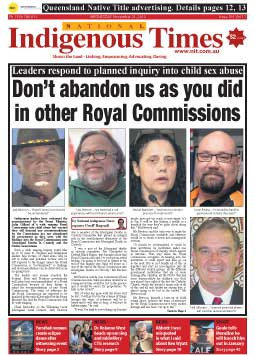
Indigenous leaders have welcomed the announcement by the Prime Minister, Julia Gillard of a wide ranging Royal Commission into child abuse but warned they will demand any recommendations by the Commission are not abandoned by government as they were with the findings into the Royal Commissions into Aboriginal Deaths in Custody and the Stolen Generations.
Such a wide ranging inquiry could take up to 10 years to complete and Indigenous leaders fear victims of child abuse will be left to suffer and potential victims will be left exposed to the danger unless the Royal Commission is "sectionalised" so findings and recommendations can be delivered on an on-going basis.
The leaders also remain sceptical the Federal, State and Territory governments will adopt any recommendations of a Royal Commission because of their failure to adopt the recommendations of past Royal Commissions. The terms of reference for the Royal Commission are expected to be finalised by the end of December but the Prime Minister has said the Royal Commission will be wide ranging.
Chief Executive of the Wilcannia Local Aboriginal Land Council, Jack Beetson was a member of the Aboriginal Deaths in Custody Committee that played an integral role in the establishment ultimately of the Royal Commission into Aboriginal Deaths in Custody.
"I was a part of the Aboriginal deaths in custody committee, The Committee to Defend Black Rights, that brought about that Royal Commission and I've just got an awful feeling I'm going to feel just as gutted at the end of this inquiry into child sex abuse as I was at the end of the Royal Commission into Aboriginal Deaths in Custody," Mr Beetson said.
Mr Beetson said he was concerned a Royal Commission into child sex abuse would be so swamped victims would be lost in the process and it would be easier for perpetrators "to hide in the crowd".
"All of what has gone with the abuse will be lost, it will get lost in the scheme of things because the terms of reference will be so broad and it will take so long, it will just be hidden again," he said.
"It won't be hard to cover things up because people have got too much to investigate, it's so big. It will be like finding a needle in a haystack the way they've gone about doing this," Mr Beetson said.
Mr Beetson said the only way to make the Royal Commission workable and effective would be to break it down into manageable sections.
"It should be sectionalised, it could be done institution by institution under one Royal Commission of inquiry which reports at intervals. That way when the Royal Commission completes its hearing into one institution, it could report and then go on to the next. But to just bundle all of this in together and start an investigation into all the different church groups, all the different government institutions that are or were looking after children, all the NGOs that had some responsibility for children, my God, you almost lose sight of the fact the Catholic Church, which has played a major role in all of this and all and sundry are saying that, is almost going to be lost in the crowd," Mr Beetson said.
Mr Beetson, himself a survivor of child sexual abuse, believes the terms of reference for the Royal Commission have been rushed through and has been "set up to fail".
"I am a person who was abused twice and I can tell you now, nothing will come out of this and it will be lucky to be concluded in my lifetime.
"One in four children in Australia have been be abused according to some reports and what worries me with this is why has the Federal Government rushed out with an announcement. Why didn't they talk to people about this first? Why wasn't there some discussion about how we should go about doing this?" he asked.
The Queensland State Chairman of Linkup, Sam Watson agreed with Mr Beetson but said Indigenous leaders were more aware of this after the refusal of government at all levels to adopt recommendations of past Royal Commissions.
"We had a very sad experience with the Royal Commission into Aboriginal Deaths in Custody and we're also still following through on Sir Ronald Wilson's Royal Commission into the Stolen Generations, so I think after those major inquiries that Aboriginal people will have the experience and the street smarts to be able to come forward and take ownership of this process and drive it to where it has to go," he said.
"I really don't believe the government is genuine about this, it reeks again of political expedience," Mr Watson said.
"But it's really now up to the Royal Commissioner, or Commissioners, to go out there," he said.
Regardless of his opinion of the government's motives, Mr Watson believes this process and the Commissioners who will guide it have a greater responsibility to the victims of decades of abuse.
"Amongst my family and across my community there are large numbers of our Elders, our families, our Linkup clients, who went through horrific abuse and have had to suffer in silence for so many years and so this is at least a glimmer of hope the perpetrators will be named, they will be exposed and they will have to face their day in court," Mr Watson said.
"Child sexual abuse affects the whole community and so the community must also have a bipartisan approach," he said.
"This has to be a bipartisan, cross-community process. Paedophilia is one of the lowest and most despicable forms of criminal activity. It has to be brought forward and the perpetrators have to be dealt with." Mr Watson said.
"I think the Federal Government has to guarantee recommendations are adopted, that this is not just another showpiece or window dressing, that the inquiry be allowed to run its full course, be resourced to do its job and at the end of the day it delivers something real, something tangible to the victims."
Chief Executive Officer of the Victorian Aboriginal Child Care Association, Muriel Bamblett agreed there have been many failures in the past and the success of this Royal Commission would depend upon the public maintaining pressure for real results.
"There have been lots of inquiries and constant reviews and what has happened to those reports? But, I think it's different this time because the Federal Government is really driving it.
"In the past there's been too much pressure put on by the churches to not have this inquiry. I think this inquiry will come up with something because it is going to be driven by people, people have had enough," Ms Bamblett said.
Ms Bamblett believes the inquiry needs to be broad so it does include Aboriginal children and adult survivors but she believes Aboriginal communities have to be actively involved to make sure they are not pushed to the back of the queue.
"I think it's going to be broad enough to include Aboriginal children," she said.
"We've been having a lot of internal discussions about our role in making sure our people come forward, because we know Aboriginal people have been abused. We know of Aboriginal people who have been abused at the hands of the church, so the inquiry is broad enough," Ms Bamblett said.
A key concern for Muriel Bamblett is the support victims of child sexual abuse will need. Counselling and support services will be essential for keeping victims safe not only during but after they have re-lived their traumatic memories.
She has seen before that as victims re-live their trauma, either through coming forward to tell their stories or through the publicity of the inquiry, there is a risk some may not be able to cope and their lives may be at risk.
"That's what happened with the Bring Them Home report and one would hope we've learnt from that process," Ms Bamblett said.
"We have to take key learnings from the Bring Them Home Report because in this case the Commissioners went out with the best of intentions but didn't realise the amount of trauma they had left behind.
Chief Executive Officer of the Gippsland and East Gippsland Aboriginal Cooperative, Jason B King believes it will be hard for the government to bury the report given the emotive and widespread nature of the child sexual assault problem but he fears there will be other barriers to a just conclusion.
"I think it will be hard for government to shelve the recommendations on this but it will be easy for them to say, 'well, that has happened in the past' and 'that was a State-run institution', similar to what happened with the stolen wages, where there were ad hoc payments instead of full reparation," he said.
"I worry the Federal Government will just palm it off to the States to implement what they see fit," he said.
Mr King believes the inquiry needs to be broad to encompass all the abuse that has happened over the years and over the many institutions involved.
He does have concerns though about Aboriginal victims being overlooked in the expansive scope of the inquiry.
"I am fearful Aboriginal children will get overlooked. They will be overlooked unless the Royal Commission looks into the boys' homes and girls' homes governments had set up all over the place.
"I think this could expose a lot of that and also the children who came out from England. I applaud Julia Gillard's decision to make it a national inquiry," he said.
The former Chief Executive Officer of the Aboriginal Legal Rights Movement, Neil Gillespie said he was worried "powerful players" would try to smother any recommendations from the Royal Commission.
"My biggest concern is it will be like other Royal Commissions, like the Royal Commission into Aboriginal Deaths in Custody," he said.
"What happens is there'll be lots of recommendations but there'll be a concerted effort for government not to implement those recommendations," he said.
"These Royal Commissions are established for political reasons, rather than what is good and just. I worry this is about a short term political gain," Mr Gillespie said.
"I'm in favour of the Royal Commission because nothing is more important than our children but unfortunately the history of governments is they are going to continue what they have done in the past with very good recommendations from various Royal Commissions and inquiries not being acted upon by government."
Comments
It's always abandonment, not one royal commission that didn't
It's always abandonment, tell me one royal commission that didn't?