
Gerry Georgatos - (courtesy of The National Indigenous Times - nit.com.au)
“There will be no bits of paper,” said Prime Minister Julia Gillard, as Acting PM, on December 28 2009 in response to a call for a Treaty by SA’s Kaurna Elder and national CEO of the Aboriginal Political Party, Lynette Crocker.
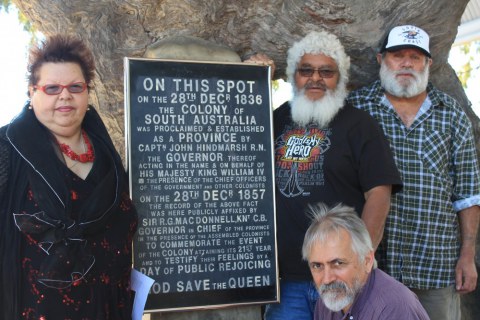
Prime Minister Gillard, South Australian bred, attended the SA Governor’s reading of the 1836 proclamation speech at Old Gum Tree reserve where she spoke as the Acting Prime Minister in the absence of Prime Minister Kevin Rudd. More than 300 attended, with then Premier Mike Rann officiating and Ms Crocker one of the speakers.
Ms Crocker said to The National Indigenous Times, “I called upon Julia Gillard to recognise the need for a Bill of Rights or Treaty with Aboriginal peoples however she rejected this, and said to me ‘there will be no bits of paper’. That Australia does not need this and more paper and I was surprised by the manner of her response,” said Ms Crocker.
Aboriginal peoples present were shocked that the Prime Minister considered Treaty or a Bill of Rights as “just paper”, and that Aboriginal rights should not amount to much more – “that they are not worth the ink” said Elders.
The National Indigenous Times emailed questions to the Office of the Prime Minister in reference to the context of her comments to Ms Crocker and other Aboriginal Elders nearby, and we asked what the Prime Minister’s official position is on the call for Treaty. One week has passed without any response which has never been the case in the past, usually the National Indigenous Times is responded to within 24 hours by the Office of the Prime Minister.
The Old Gum Tree is a historic site in Adelaide’s seaside Glenelg North. On December 28, 1836 it is said British Governor John Hindmarsh delivered the ‘proclamation’ creating the Colony of South Australia. A ceremony is held on each year on Proclamation Day with the incumbent Governor reading out Hindmarsh’s original speech.
The tree itself, a red gum, has long since died and its decayed outer surface in 1963 was encased in concrete.
“We need a Bill of Rights for our peoples and till this happens Australia cannot move forward in the ways it should. In 1836 King William IV recognised in the Letters Patent our peoples with rights however governments since turned a blind eye to this. We have to educate all our people about their legal rights, about the Letters Patent – because its legal status today is as it was in 1836, and if more of our people understand it then we have something even bigger than the Mabo decision. It is bigger than Native Title and would enhance Native Title rights.”
At the 2010 Proclamation reading at Gum Tree Ms Crocker gave Prime Minister Gillard a book by lawyer Shaun Berg on the Letters Patent and the legal rights of South Australia’s Aboriginal peoples while refreshing the Prime Minister with her call for a proper and respectful Treaty.
LINKS:
http://www.nit.com.au/news/2020-the-day-julia-gillard-said-no-to-a-treat...
The Day Julia Gillard said NO to Treaty
It was the day Prime Minister Julia Gillard gave South Australia's Elders a clear pointer to her views about entering into a treaty with this country's First Peoples and that was it won't happen on her watch.
http://www.nit.com.au/news/2021-south-australian-elders-set-the-record-s...
South Australia's Aboriginal Alliance Coalition Movement (AACM) wants "the Aboriginal record set straight" in reference to the State's official acknowledgment of the State's colony, proclamation and the Letters Patent because it goes to the heart of Aboriginal legal rights.
http://www.nit.com.au/news/2019-south-australia-continues-its-assault-on...
http://www.nit.com.au/news/622-more-leaks-hit-pms-office-with-new-claims...
http://www.nit.com.au/news/545-plan-to-embarrass-abbott-involved-detaile...
http://www.nit.com.au/opinion/525-georgatos-my-personal-look-at-the-tent...
http://www.nit.com.au/news/514-abbott-picks-a-fight.html
http://www.nit.com.au/news/513-source-claims-pm-knew-about-leak.html
http://www.nit.com.au/news/511-prime-ministers-man-quits-over-leak-to-te...
http://indymedia.org.au/2012/02/28/lobbygate-the-prime-minister-would-ha...
http://indymedia.org.au/2012/06/12/hra-release-it-is-not-that-charges-ne...
http://www.theage.com.au/national/pms-staffer-did-not-act-alone-report-2...
http://indymedia.org.au/2012/04/22/source-spills-beans-on-government-pmo...
http://www.sbs.com.au/yourlanguage/aboriginal/highlight/page/id/204013/t...
http://www.sbs.com.au/yourlanguage/aboriginal/highlight/page/id/204717/t...
http://lefthack.net/the-national-riot-mismanagement-squad
http://www.theaustralian.com.au/national-affairs/julia-gillard-staffer-d...
and ELDER LYNETTE CROCKER'S speech on the same day the Prime Minister said to her 'No Treaty':
Naa marni Yelteriburkunna, Ngangkunna, Meyunna, Mankarranna, Tinyaranna Good morning, Distinguished Guests, Ladies, Gentlemen, Girls and Boys):
In my speaking here today the Kaurna Meyunna want to share, Your Excellency, Prime Minister, Premier/ Ministers, other dignitaries, distinguished guests, ladies and gentlemen, and children, the common humanity we enjoy as dignified human beings together.
This may be summed up in the accountability to ourselves and our communities and society that we treasure through our personal responsibility to live with a common purpose for the general welfare and in a critical self-respect for the conduct of our individual lives.
But there is still amongst us Aboriginal people here this morning much mixed feeling about the values and principles we need to live by together to uphold that accountability and take that responsibility each and every day of our lives.
Our contribution to the 2010 commemoration of the commencement of English government over the Kaurna Yerta and other Aboriginal Descendants, which enfolded our destiny and our land without our ancestors elicited consent in South Australia, raises an enduring conundrum that Governor Hindmarsh sought to resolve here at this spot 174 years ago when he granted us the full legal and citizenship rights to participate as equals with all the English arrivals in the future of South Australia under the English law he then instituted.
Your Excellency, your original predecessor did this with that bit of paper issued by Colonial Secretary Gouger 174 years ago, which has given the name of the celebration we are here now undertaking – Proclamation Day.
What is apparent to us Aboriginal people is that this bit of enormously important paper to both of us, and which first names this place as Glenelg, presents us with a conundrum because it contains within it the first domestic implementation of the charter of rights that South Australia has and set out solely for our enduring benefit from the founding Letters Patent of 1836 establishing South Australia and which underpins our gathering together.
This charter of our rights in the Letters Patent of 1836 also underpinned the attainment of the first Aboriginal Land Rights in 1966 and in South Australia – the Aboriginal Lands Trust Act.
To all of us on the one hand the Proclamation is considered by South Australia to be fully honoured in its observance in the ongoing development of the State and that is why it is being honoured here today by Your Excellency.
While on the other hand it is considered by us the Descendants of the Original Owners to be observed, in the main, in its breach because it is this charter within the Proclamation that officially has been cashiered and rejected in the practice and conduct of the origination and development of South Australia not too long following its insertion within the Proclamation.
We feel that is being denied solely because it upholds our rights, Aboriginal rights, within the letter of the Original Charter for our Land Rights – the Letters Patent of 1836 which preceded it, but without a reservation of any right for South Australia to override and deny them as it so brazenly has done without a just regard to our co-extensive British rights and entitlements.
This injustice imposed on us compels us Kaurna Meyunna and our fellow Aboriginal brothers and sisters here today with us, to bring before you the dilemma we suffer of how to have you resolve together with us in justice a new shared future in the commemoration of the Letters Patent over the next twelve months, which is the 175th commemorative year of King William IV’s initial terms to inaugurate a just foundation of South Australia under the Letters Patent.
The conundrum we daily face is whether you will still remain deaf to us and our rights that subsequent to the Proclamation have been denied in the development of South Australia or whether you will hear us and correct your predecessors’ entrenched denial by taking up and facing the challenge of responsibility and being accountable for what has transpired.
Your dilemma is whether you will go on as you do requiring responsibility and accountability from us, while all the time still denying that South Australia reciprocally at least owes us that.
What we are seeking is that bright and just future for all that is only based upon an equal and democratic negotiation by all. Let me share a vision we have been raising for you to hear.
The fundamental relationship between all the people as the governed and the government in South Australia inaugurated 174 years ago today has not yet been politically spelled out in a fully democratic, equal and just process within the life of the State, and solely because we the Aboriginal people lack due constitutional recognition and respect for our original land rights in the State.
The Constitution of the Parliament of South Australia was drafted by a 19th Century Premier of South Australia, without the fully democratic consultative involvement of all the whole people of the entire community, and so lacks the just Aboriginal input about our rights.
Of main concern for the better future of South Australia is the just, equal and democratic treatment of all South Australians by government, and especially of all Aboriginal people, within a just and reciprocal recognition and equal respect for our prior equity.
At the heart of the principle of a social contract between the people and government is the right of the whole community to determine its future by making society accountable to the State under justice and within a just system of laws.
South Australia began in an 1834 Act of a colonising British Parliament in London half-way around the world, and in its unenforceable preamble unjustly appeared to ignore all local Aboriginal people as persona nullius outside equity, despite our inherent proprietary rights.
The founding legislation for South Australia was an ignominious start to what is now a clearly unjust 174 year colonising history of continuing shameful infamy for all Aboriginal people, who are yet to be asked to establish any form of reciprocal legal relations with the State.
Central to the Wakefield Plan for colonising the Aboriginal lands of South Australia was a reputed repugnance for race slavery, and the sharp securing of a privileged English social contract for a few, while dispossessing all the traditional owners.
Slavery had been abolished legally in Britain and its colonies from 1833. A worst fear faced by English emigration to South Australia was to be seen guilty of enslaving the Aboriginal people. To that end in part the inaugural implementation of the Charter of the Letters Patent at this spot 174 years ago ensured that we Aboriginal people were British subjects by law. But beyond Governor Hindmarsh this was treated as only a nominal right in justice because taking our lands was claimed to be justified under the 1834 Foundation Act.
In ensuring against legal penalisation for slavery and avoiding allegations of slavery, later government in South Australia ensured Aboriginal people were subsequently deprived of any right of survival or equity in our lands and initially refused the right to work. It was this malign
design for injustice that was especially incorporated in the subsequent legal establishment of the institutions under which South Australia developed.
The false legal doctrine of terra nullius, was first developed to deny our Aboriginal equity and rights by English law in the unenforceable preamble of the Foundation Act of 1834 with the view to entrench permanently this injustice in the State's legal and constitutional framework. Although it was first refuted by William IV in the 1836 Letters Patent, it remained alive to be abrogated for 156 years until it was set to rest by the 1992 Mabo judgment of the High Court.
Owing to this history of South Australian injustice there remains a basic need for the people of South Australia to reject and redress this ignominy of our past and to go forward together with us local Aboriginal people for a brighter, equitable and just future in a better community.
The traditional way to achieve unison of this nature, both among Indigenous and immigrant cultures alike, is for a social compact or contract to be formulated to establish a future pact within the State through the Parliament to uphold justice.
The whole community must be consulted and all Aboriginal Descendant groups must have the legal right to negotiate with government in the make-up and terms of a rewrite of the State's Constitution, which must extend to including a specific Aboriginal Bill of Rights.
It is up to the community to extend the hand of partnership and co-operation to all people and groups in the State, by upholding human rights to reform South Australia to be inclusive of everyone's rights by instructing the Parliament to enact this by a Bill of Rights.
Comments
like there are two different Labor Parties
Very shocking after the Apollogy. It is like their are two different Labor Parties. One with a heart and one that is heartless. Disrespecting Aboriginal Peoples is not the way forward for the Australian Nation. Julia Gillard's team also abused and used Aboriginal People on Australia Day 2012, for some backfired political gain. Where is the true vision, the true leadership?
There should be a Treaty
Yes there should be Treaty between Aboriginal people and the rest of Australia, just like in New Zealand, what's the big deal? and it will help move forward and people out of poverty.
Gerry, thanks for all these stories, I can't read them all online at the National Indigenous Times because of access but I do get the newspaper because of you and you have done some great writing and coverage this year, and I appreciate to read for free some of the stories here on Indymedia as soon as they come out.
Candle Light Walk to call for a Treaty and Bill of Rights
Subject: 143rd Justice & Peace Candle Light Walk around Government House, Adelaide (Friday 2nd November from 7.45PM for 8.00PM walk).
Join us on the Candle Light Walk to call for a Treaty and Bill of Rights, and to support the Ngarrindjeri and all other Aboriginal people and the Stolen Generations, their families and communities left behind, in their call for Peace and Justice. Show them our strong lights for their rights and tell them how sorry we are for the wrongs they endure. Ask our Government to sit down and work out with the descendants of the Original Australians and their Stolen Generations how to repair the damage done. Ask our fellow Australians to join together to establish equal rights for us all - visit: http://antarsa.auspics.org.au/
If you can't get to the Adelaide walks, start your own 2013 Candle Light Walks around your local Government House/Town Hall.
UPDATE BULLETIN - 1: SA's proposed Murray-Darling High Court action to be dropped: SA Premier Jay Weatherill
http://www.abc.net.au/news/2012-10-26/gillard-announces-murray-darling-p...
Gillard announces Murray-Darling plan changes By chief political correspondent Simon Cullen, staff - Updated Fri Oct 26, 2012 8:46pm AEDT
Prime Minister Julia Gillard has pledged $1.7 billion over 10 years as part of plans to significantly increase environmental flows in the Murray-Darling river system. The bulk of the money will be used to make farms more water efficient and remove "capacity constraints", such as low-lying bridges that limit water flows down the river. ... The Prime Minister's announcement has won the immediate backing of South Australian Premier Jay Weatherill, who says he will drop proposed High Court action against the basin plan if the new measures are adopted.
"I asked all South Australians to stand up and make their voices heard and they have; irrigators, environmentalists, city and country folk have answered that call getting involved in the campaign," he said. "A simple demand was to listen to the scientists to return more water and the Federal Government have now done that, so this is a very big day for South Australia."
UPDATE BULLETIN - 2:
BUT WHAT ABOUT RADIATION FROM THE BRITISH MARALINGA A-TEST FALLOUT THAT SETTLED IN THE MURRAY-DARLING BASIN & MURRAY RIVER ?
Where in the Murray-Darling re-vamped Plan is there action to deal with the accumulated radioactive pollutions from the 20th Century British A-testing and their impact on the First Nations of the Murrundi (River Murray), Lakes and the Coorong ? Recent scientific information from what is still happening from Fukushima shows that radioactive caesium which enters a marine ecological system remains in the environment and therefore the food chain for decades.
http://www.abc.net.au/news/2012-10-26/radiation-settles-on-japan-seabed/...
Radiation settles on seabed off Japan - By North Asia correspondent Mark Willacy, wires Posted Fri Oct 26, 2012 2:15pm AEDT
New research suggests radiation from the crippled Fukushima nuclear plant has settled on the ocean floor off Japan, and could contaminate sea life for decades. Marine chemist Ken Buesseler of the Woods Hole Oceanographic Institution reviewed official Japanese data on radiation levels in fish, shellfish and seaweed collected near the crippled nuclear plant. He concluded the lingering contamination may be due to low-level leaks from the facility, or contaminated sediment on the ocean floor. His research, published on Thursday in the US magazine Science, estimated that about 40 per cent of fish caught near Fukushima are considered unfit for consumption under Japanese regulations.
"To predict how the patterns of contamination will change over time will take more than just studies of fish," he said.
"What we really need is a better understanding of the sources and sinks of cesium and other radionuclides that continue to drive what we're seeing in the ocean off Fukushima."
Cesium levels vary across fish types, though Mr Buesseler also found that bottom-dwelling fish consistently showed the highest cesium counts. Levels of contamination of almost all types of fish are not declining, even though the levels vary, the study showed. Mr Buesseler stressed that the levels of radiation found in the vast majority of fish caught off Japan's north-eastern coast remain below safe limits for consumption, which the Japanese government tightened in April this year.
A huge tsunami, sparked by a massive 9.0-magnitude undersea earthquake, swamped the Fukushima Daiichi nuclear plant in March 2011. Reactors went into meltdown, spewing radiation over a large swathe of Japan's agriculture-heavy north-east. Around 19,000 people were killed or remain missing.