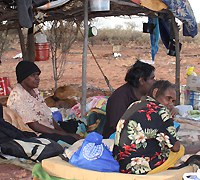
Irene Khan, Amnesty International Secretary General, announced after spending a week visiting Aborigines in central Australia, "In the heart of this first world I found scenes more reminiscent of the third world. That Indigenous peoples experience human rights violations on a continent of such privilege is not merely disheartening, it is morally outrageous. The moral imperative to eradicate such poverty is no less an imperative on government than to eliminate torture."
Full coverage Sydney Indymedia
Visit the Amnesty Website to send a message to the Federal Government to stop discriminatory measures in the NT.
Article By Claire Mallinson, National Director, Amnesty International Australia
As global leader of Amnesty International, Irene Khan has witnessed some of the worst poverty and discrimination in the world. From Brazil to Bangladesh, in her eight years as Amnesty International Secretary General, Irene Khan is well placed to assess how government policies can impact the lives of people in the world’s poorest places.
That’s why when she speaks out against the "inexcusable, unexpected and unacceptable" conditions affecting Indigenous people on our own doorstep, politicians must sit up and take notice.
During a week’s visit to Australia Irene went to the Utopia Homelands, a group of Aboriginal communities a five-hour drive on dirt roads north-east of Alice Springs. There she met Elsie, who was squatting in the raw dirt of an open field, surrounded by all her belongings.
Through an interpreter she said: "I pay rent to the government for sleeping on a mattress in the desert, I have no home, I do not have my voice, no one is listening to me or my family. No one wants to know what we see, what we think, what we know would make this right."
Elsie's sense of exclusion is shared by all the people Irene met in Utopia. It’s outrageous that more than 45,000 Aboriginal people are still subject to racially discriminatory measures, including compulsory quarantining of social security payments, as a result of the government's Northern Territory Emergency Response. Click here to call on Indigenous Minister Jenny Macklin to urgently reinstate laws that protect people like Elsie, and forge a new approach grounded in a genuine respect for traditional cultures.
In the heart of the first world Irene Khan saw scenes more reminiscent of the third world. How is it possible that in Australia - the land of the fair go - its own first peoples are living in such appalling poverty?
Our politicians must answer this question, and they have been stalling for too long. The government will not secure the long term protection of women and children unless there is a community-driven human rights solution.
Next week the government will introduce legislation to reinstate the Racial Discrimination Act. Now is the critical time for the Australian government to reset the relationship with Indigenous peoples and seize the opportunity for change.
Irene Khan's message to the Australian government to stop discriminatory measures affecting tens of thousands of Indigenous people is already making waves in the media.
ABC Coverage
http://www.abc.net.au/news/stories/2009/11/18/2746678.htm?section=justin
Sydney Morning Herald
http://news.smh.com.au/breaking-news-national/indigenous-poverty-outrage...
ABC News 23 Nov
Indigenous leader Mick Dodson says a plan to re-instate the racial discrimination act in the Northern Territory is at odds with the intervention in Indigenous communities. - http://www.abc.net.au/news/stories/2009/11/22/2749757.htm