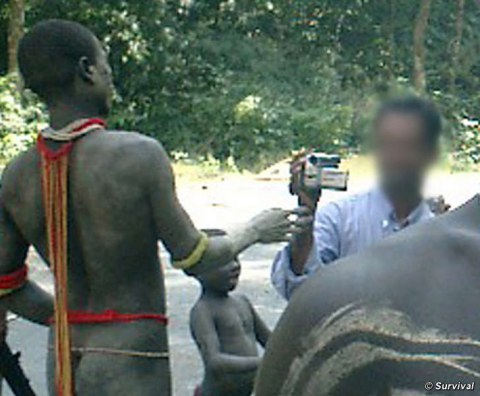
A tourist films Jarawa on the Andaman Trunk Road.
© Survival
SURVIVAL INTERNATIONAL, January 9, 2012 -- British newspaper The Guardian has revealed evidence of police involvement in ‘human safaris’ in India’s Andaman Islands.
The scandal, first exposed by Survival International in 2010, involves tourists using an illegal road to enter the reserve of the Jarawa tribe. Tour companies and cab drivers ‘attract’ the Jarawa with biscuits and sweets.
The Observer has obtained a video showing a group of Jarawa women being ordered to dance for tourists by a policeman, who had reportedly accepted a £200 bribe to take them into the reserve.
One tourist has previously described a similar trip: ‘The journey through tribal reserve was like a safari ride as we were going amidst dense tropical rainforest and looking for wild animals, Jarawa tribals to be specific’.
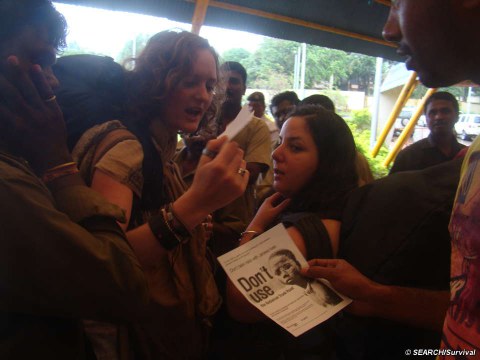
 Local organization SEARCH hands out leaflets at the
Islands’ airport warning of the dangers of using the
road. © SEARCH/ Survival
In recent weeks the Islands’ administration has again ruled out closing the road, known as the Andaman Trunk Road – but revealed for the first time that it plans to open an alternative route by sea to bypass most of the Jarawa reserve.
Survival International has called for tourists to boycott the road, which the Supreme Court ordered closed in 2002. Working with a local organization, SEARCH, Survival has distributed leaflets to tourists arriving at the Islands’ airport warning of the dangers of using the road.
Survival International’s Director Stephen Corry said today, ‘This story reeks of colonialism and the disgusting and degrading ‘human zoos’ of the past. Quite clearly, some people’s attitudes towards tribal peoples haven’t moved on a jot. The Jarawa are not circus ponies bound to dance at anyone’s bidding.’
Undercover audio tape proves Andaman ‘human safaris’ continue
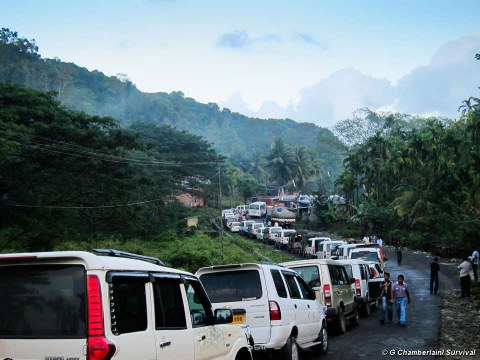
 Vehicles queue to enter the Jarawa reserve along the
Andaman Trunk Road. © G. Chamberlain/ Survival
A secret recording of a tour operator in the Andaman Islands telling an undercover journalist to provide 10-15,000 rupees (£120-180/ $180-275) to pay off the police proves that the now notorious ‘human safaris’ are still happening, and provides fresh evidence of police involvement in the scandal.
The tape was recorded last month by journalist Gethin Chamberlain.
Asked how much a trip to see the Jarawa tribe would cost, the Port Blair-based tour operator says, ‘For the trip, uh, vehicle and… all like 25 to 30,000 like that. Because the policeman take 10 to 15 like that. And vehicle and some gift to the tribals also… like fruits, biscuits…’
Hear the conversation and read the transcript by clicking here.
Stung by the international outrage that has greeted these disclosures, some in the islands’ administration have claimed that the video was shot ten years ago, before precautions were put in place – but the new audio recording proves that they continue today.
In response to the latest revelations, one of the leading experts on the Andaman Island tribes, Professor Anvita Abbi of Jawaharlal Nehru University, has said, ‘This happened in the knowledge of the authorities. How can the administration claim they have no knowledge of this?’
Stephen Corry said, ‘This recording provides concrete proof that human safaris are still occurring. The only reason that they are still occurring is because of the Andaman Trunk Road through the Jarawa reserve. Ten years after the Indian Supreme Court ordered the road to be closed, it's shocking that the Andaman Administration is defying this order by keeping it open. The government could end human safaris today – by closing the road.’
Survival International alerted the Andaman authorities to the existence of human safaris two years ago.
On 11 January 2010 Survival wrote to the Lieutenant Governor of the Islands, warning him that ‘a number of tour operators are promoting tours which include sightings of, or encounters with, the Jarawa tribe'.
Survival received no response to the letter or subsequent appeals, even after launching a boycott of the Andaman Trunk Road with local organization Search.
In July 2011, Survival wrote again as a matter of ‘great urgency’, in response to ‘severe international concern about the Jarawa’s predicament and the threat that tourists pose’, but still the problem continued.
Four months ago, a complaint was also lodged by social worker Arvind Rai Sharma, after he saw a tour company’s promotional video of Jarawa women and children being ‘humiliated in front of tourists’.
Speaking to Survival, he said, ‘I personally handed in the letter to the Andaman authorities, and met the Director of Tribal Welfare. But they still did not take my complaint seriously, even though it was such a sensitive matter'.
Stephen Corry said, ‘It’s extraordinary that the local government appears only now to realize the extent of these ‘human safaris’. Survival first wrote to the administration in 2010 to highlight the issue. If they’re serious about finally tackling this problem, they need to close the Andaman Trunk Road, ten years after the Supreme Court told them to. It’s the only real solution.’
Read Survival's letters to the Andaman administration from 2010 (pdf, http://assets.survivalinternational.org/documents/695/jan-2010.pdf, 294 KB) and 2011 (pdf, http://assets.survivalinternational.org/documents/694/july-2011.pdf, 229 KB)