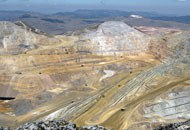
Yanacocha open-pit mine
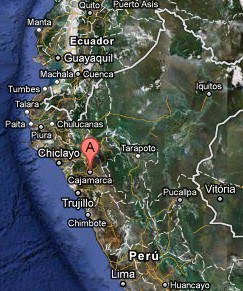
By Klaus Schenck, at Rainforest Rescue More than 8,000 farmers have been guarding dozens of mountain lakes at an altitude of 4,000 metres in the Peruvian Andes. The natural water reservoirs are acutely threatened by gold mining. The lakes are vital as water sources for livestock and agriculture in the valley. The farmers are calling on the new Peruvian president to fulfil his campaign promise and speak out against the Conga gold and copper mining project.
Please help the farmers and the other people of Cajamarca defend their fundamental rights and water sources by signing our petition here. A translation of the letter to the president is here.
Also, please do not buy gold. Do not give gold as a present. Instead, please consider supporting the defenders of the rainforest and giving a rainforest certificate this holiday season.
 The population of the city of Cajamarca supports the protests of the highland farmers with demonstrations on the central square.
Day after day, more than 20,000 people have gathered at the historic Plaza de Armas in a peaceful demonstration with the slogan “Congo no va!” (no Conga!). Together with the political representatives of the region they are demanding a guarantee of the inviolability of the mountain lakes.
The city dwellers are also impacted by the risks of mining. They have had to cope for years with acute water shortages and pollution at the foot of the Yanacocha, the largest gold mine in Latin America. The same company now wants to realize the Conga project.
In its efforts to resist the mining industry, the population of Cajamarca was hoping for the support of Peru’s new president, Ollanta Humala.
During his campaign, he promised to protect the water sources and thus ensure food security in Cajamarca, an important Peruvian agricultural region. The population, a majority of which voted for the President’s party, is now in a state of shock.
Last weekend, Humala imposed a state of emergency in four provinces of Cajamarca and sent in the military to occupy the city. Several people were injured, at least one seriously, in violent clashes with special forces.
The environmental impact study for the Conga project produced by the company has been criticized by the Peruvian Ministry for the Environment. Deputy Environment Minister Jose de Echave resigned in protest over the Conga project.
Please sign our petition to demand an end to the violence and support the people in striving for self-determined development in harmony with nature.
Open-pit gold and copper mining requires huge amounts of water and energy. Already in the initial phase of the project, four major natural lagoons are threatened with destruction.
These vital Andean reservoirs feed rivers, canals and marshes well into the lowlands.
In its environmental impact study, Yanacocha stated its intention to build four artificial canals to reduce environmental damage: one to serve the mining operations, and three to supply the surrounding population centres.
Given the number of affected communities, experts doubt that the company’s plans will be sufficient to ensure an adequate water supply. In Peru, more than 60 social conflicts have arisen from the adverse effects of mining on the population’s water supplies.
The new Conga project is located only a few kilometres from the main Yanacocha mine, which already covers an area of 251 square kilometres and is operated by a U.S.-Peruvian consortium.
The main shareholder is the Newmont Mining Corporation in the United States, one of the world’s largest gold producers. The International Finance Corporation, the arm of the World Bank Group focused on supporting private sector development, has owned a 5% share in Minera Yanacocha since 1993. Minera Yanacocha is a joint partnership between Newmont Mining, Compania de Minas Buenaventura and IFC. Minera Yanacocha owns the Yanacocha Mine as well as the proposed Conga Mine.
Cyanide is used to extract gold, silver and mercury in the open-pit mining operation. The leaching process requires vast amounts of water. Despite the mine operators’ continual assurances regarding the safety of the process, mass fish deaths have repeatedly affected the rivers and lakes of the region. Farmers complain that their cattle become sick and die due to water shortages and pollution.
Even the promise of economic development for the Cajamarca region remained unfulfilled. In 1993, at the start of Yanacocha’s mining activities, Cajamarca was the fourth poorest region in the country. 18 years later in 2011, it remains so.
In 2000, Yanacocha was responsible for one of the world’s largest mercury accidents. A company truck lost 152 kg of mercury on the road through the village of Choropampa.
Rather than informing the population of the danger, the company called on villagers to collect and hand in the toxic metal. Over 2,000 people were exposed, and to date 20 have died of mercury poisoning.
To this day, Yanacocha has not admitted any responsibility. In his research, the author of this article found that people are still suffering from the consequences of the accident ten years later. An award-winning documentary (English sub-titled) recounts the events.
http://www.nodirtygold.org/dirty_golds_impacts.cfm
Asia Pacific Newmont's largest asset

Newmont write on their website: "During the past decade, Newmont's Asia Pacific region has grown to become the company's largest asset. These years have brought tremendous opportunity and challenges to the company, from the discovery of additional ore reserves to ensuring the responsible management of local environments.
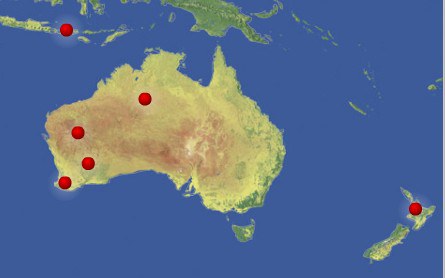
Newmont acquired its Australian, New Zealand and Indonesian assets as part of the acquisition of Normandy Mining in 2002, and mining in Indonesia began in the late 1990s. Newmont also has the Martha open pit and Favona underground mines in Waihi, New Zealand.
Our newest Australian asset is the Boddington operation, which poured its first gold in September 2009 and produced its first one million ounces in March 2011. In 2010, Boddington Gold produced 728,000 ounces of gold and 58 million pounds of copper.
Go here for their descriptions of their operations in Boddington, Jundee and Kalgoorlie in Western Australia and Tanami in the Northern Territory.