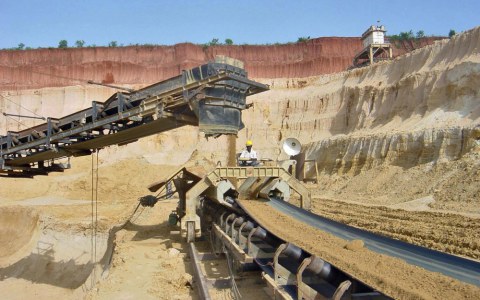
By Gerry Georgatos - courtesy of The Stringer - http://thestringer.com.au/ - May 18th, 2014
Human greed is ravaging the earth, wiping out billions and millions of years-old-management systems, making extinct millions of species, forever changing the world’s landscape. Rapacious greed for the urbanisation of the planet is unsettling the earth to the point that alarmists have justification in arguing a future tumult of scarcity wars, never-before-seen ‘natural’ disasters, civil strife and the loss of human life not just in the millions but in the billions.
Singapore has expanded its coastline, increasing its territory by more than 20 per cent in the last half century, but at the expense of some of its neighbouring States. Singapore has expanded its territory by more than 130 square kilometres, with another 100 square kilometres to be completed by 2030. They have manifested this land mass with what should have remained generally unimaginable quantities of sand.
Densely populated Singapore does not have the sand hills or reserves to have extracted the quantities of sand that was needed. The sand has been imported from neighbouring poor nations – Malaysia, Cambodia, Vietnam and Indonesia, but these countries have now banned sand exports. The excavation of what should have always remained unimaginable quantities of sand has caused irreparable environmental degradation to whole regions of these nations – resulting in the loss of ecosystems and in the relocation of human habitats. But because of extreme poverty, sand smuggling occurs with traffickers loading up to 3,000 tonnes of sand on their boats and chartering them towards eager Singapore and other nations. Companies have set themselves up to profit from the increasingly scarce resource – indeed there are now sand mafias.
But sand smuggling alone cannot meet humanity’s increasing demand for sand, which after water is the most in demand resource. Sand is cheap but in huge quantities is lucrative for exporters and the carpetbaggers, the middle agents, those who on sell to Governments and the profit-driven developers. Australia, a once seemingly limitless source of sand is one of the hugest suppliers of sand to south east Asian developers and to ironically sand-hungry Dubai. But to meet the huge demand that even the vast continent of Australia alone cannot provide sand is dredged from sea beds. Not all sand is the grade required for construction or for technology – the Sahara’s sand, like the sand of the Saudi peninsula, is too fine to be used in construction. The fineness of Sahelian and Saudi sand is in fact dangerous, and would lead to the inevitable collapse of buildings, unlike the rough and heavier sand of Australian beaches or that from the earth’s sea beds.
Expensive $100 million to $200 million gigantic tankers dredge sand from ocean beds, up to 300,000 tonnes of sand to a load. The dredging causes environmental disturbances, shifts to the sea beds that have cumulatively led to the disappearance of islands, to rising sea levels that have seen coastlines disappear – for instance in the Maldives. It is not just human induced climate change that is threatening the world’s coastlines but also the human greed for unsustainable extraction of resources, in this instance, sand.
Sand trafficking is huge, on every continent, from the beaches and coastlines of Morocco to south-east Asia, but the multinational robber barons do it every day, dredging it from the planet’s sea beds and similarly so profiteers extracting from the coastline of every nation. Countries which have banned sand exporting and who try to regulate sand mining are undermined by wealthy nations with an insatiable demand for sand and who do knowingly allow for the setting up of shelf companies whose prescribed purpose is other, but a guise to illegally import sand, brought in by ships officially designated for other purposes to the sand they carry and which they offload at the port – in front of not only the port authorities but effectively in front of the Governments who have instructed that there shall be a turning of a blind eye and even a helping hand where needed.
Singapore is one of the nations who depend on the illegal trade, and who like Japan with its whaling con for far too long, can only be seen to be lying when they argue that they do not condone sand trafficking and that they respect their ASEAN neighbours. Far too many wealthy nations are artificially extending their land mass and engaging various largesse, such as with tourism wonders and ostentatious living, but by taking effectively the land away from under the feet of others.
The environmental damage of the sand trade has been excruciatingly damaging, with Cambodians having been forced off their lands and out of their communities because of the sand mining, the dredging, the destruction to their rivers and streams. Other communities that have not been relocated languish in environmental degradation and in extreme poverty.
Dubai’s artificial palm island coastline adds 56 kilometres of coastline to the little nation’s 72 km coastline. No island this size had ever been built before – and all of it with sand – 94 million cubic metres of sand. Is there enough sand in this world to go around without degrading environments and without unbalancing the eco-defences of the earth?
The Sand Wars was produced in 2013, directed by Spanish filmmaker, Denis Delestrac. “Most of us think of (sand) as a complimentary ingredient of any beach vacation. Yet those seemingly insignificant grains of silica surround our daily lives. Every house, skyscraper and glass building, every bridge, airport and sidewalk in our modern society depends on sand.”
“We use it to manufacture optical fibre, cell phone components and computer chips. We find it in our toothpaste, powdered foods and even in our glass of wine.”
“Is sand an infinite resource? Can the existing supply satisfy a gigantic demand fuelled by construction booms?”
“What are the consequences of intensive beach sand mining for the environment and the neighbouring populations?”
“Based on encounters with sand smugglers, barefoot millionaires, corrupt politicians, unscrupulous real estate developers and environments, this investigation takes us around the globe to unveil a new gold rush and a disturbing fact, (that) the Sand Wars have begun.”
The Sand Wars was first broadcast in May last year in France and Germany and the documentary inspired the United Nations Environment Programme to publish a Global Environment Alert in March 2014 titled ‘Sand, rarer than one thinks’. But the United Nations has never been in a position to positively change the world for the better to where it reaches a point that it outpaces the damage and the carnage. The ‘alert’ has gone out but the sand mining continues to increase in volume.
Despite sand used in every corner and crevice of the world, despite it being in far too many daily products to list – no electronic chip can be manufactured without high quality sand – it is construction that has the most voracious appetite for sand. In the last 150 years the human craft of construction has changed the landscape of the planet, but we are running out of sand.
It takes about 200 tonnes of sand to build an average sized house, 3000 tonnes for a large sized public building. It takes 30,000 tonnes for each kilometre of highway. It takes an estimated 12 million tonnes of sand to construct an average sized nuclear reactor. There are more than 400 nuclear reactors on the planet with the nuclear industry aspiring to thousands more reactors by 2100. Tens of billions of tonnes of sand are used each year, more than any other resource – with the exception of water.
Dennis Delestrac reports that by the end of the 21st century, beaches will be a thing of the past. This is the alarming forecast of a growing number of scientists and environmental NGOs. Sand has become a vital commodity for our modern economies. It is not just that we will be looking for alternatives to the sand that we take for granted today but we will also have to deal with the impacts that the tempest of human greed will tumult upon humanity – rising sea levels, erosion, environmental degradation and ‘natural’ disasters, cataclysmic stuff.
Sand Wars trailer - https://www.youtube.com/watch?v=CAPfwwb59uY
Interview with Denis Delastrac – the world running out of sand - https://www.youtube.com/watch?v=t2LkJAAifz4
Megastructures - https://www.youtube.com/watch?v=0BXGh0EYJtE
Shifting Sand - https://www.youtube.com/watch?v=hrZg1QmTiFQ
Article in The Stringer - Quandamooka sand is worth more than gold
by Gerry Georgatos - June 15th, 2014
Quandamooka sand may be here today, gone tomorrow. Sand is the world’s most in demand resource, and before long the world will be without sand for urbanisation’s insatiable urges, and for technology’s production lines. The Queensland Government and the multinational robber barons know this. That Trojan Horse, the Native Title Act should have protected the rights of the people over their land’s deposits of sand. This is not a resource deep in the earth like ores and minerals which are freed up to robber barons and profiteers under exploitive laws. Native title is about the lands and seas and not what is deep within the, such as minerals and ores. By fact of being below the surface minerals and ores are not the property of any particular people or the responsibility of the custodians of the environment so native title would have it – it is only the access to their lands that is a point of potential negotiation according to native title. But sand is not found below the surface.
Quandamooka Yoolooburrabee Aboriginal Corporation (QYAC) has challenged the Queensland State Government in the High Court of Australia for its oligarchical decision to extend sand mining for an additional 16 years on North Stradbroke Island.
What is not being said in the squabble over whether the Government should have extended the sand mining is how lucrative the supplying of sand is and how much in demand it is. Sand is in such demand that far too many Governments and profiteers will take as much of it as they can even if it means environmental degradation and irreparable effects. Sand smuggling and sand trafficking is a huge business right around the world. Singapore’s territory mass has been extended by 20 per cent in the last three decades, and this has been achieved from the sand of neighbouring countries. Many ASEAN countries, like Indonesia, Malaysia, Cambodia, Laos and Vietnam have banned sand exports because of the degradation to the environment which has meant whole communities have had to relocate.
Sand in large quantities is lucrative, and as per usual the carpetbaggers have jumped in. The demand is so huge that ships worth hundreds of millions of dollars dredge the ocean’s sea beds daily, so Australia’s onshore supply cannot be missed by profiteers.
The Queensland Government bypassed the people of North Stradbroke and bypassed environmental and human habitat considerations and amended the North Stradbroke Island Protection and Sustainability Act, extending sandmining onwards from 2019 to 2035. Quandamooka Elders did not consent to the extension.
What is the point to the Native Title Act when it is bypassed altogether? But Dr Gary Foley once said it best, “Native Title is not land rights, reconciliation is not justice.”
Quandamooka Elders lodged a writ in the High Court against the Government only a fortnight ago. This followed a Traditional ceremony on the island.
QYAC Chair of the Board, Cameron Costello believes the Native Title Act will save the day for the Quandamooka. This is a huge call, because for the most part it never has for anyone. The silence from the National Native Title Tribunal is deafening. That though is not news.
“Campbell Newman’s Government wrote to us in 2012 saying they wanted to meet to extend sand mining and if we didn’t meet they were going to suspend our native title benefits,” said Mr Costello. These types of threats are not uncommon. In Western Australia Premier Colin Barnett’s threats of compulsory acquisition are now well worn.
“From that letter to us, the State knew it was breaching our Indigenous Land Use Agreement.”
The Quandamooka people had only scored native title rights in 2011.
Now the background that stirs questions as to the Newman-led Government’s decision to extend the sand mining is that in 2011, after the Quandamooka’s native title rights were secured in the High Court, the Anna Bligh-led Government passed the North Stradbroke Island Protection and Sustainability Act, which was crafted by Environment Minister Kate Jones and in liaison with the Quandamooka Elders. The Act phased out the sand mining on the island by 2019, dedicating 80 per cent of the island to a national park, to be in effect by 2027. But sand is in higher demand than most other resources.
Without too much delay, soon after the incumbent Government came to power in 2012, they amended the Act in October last year, passing it in November. Mines Minister, Andrew Cripps tabled the amendments.
Minister Cripps pushed the line that he acted in the interests of Stradbroke residents who were dependent on the sand mining for their employment and that 2019 is too early to phase out the mining. The mining companies are only too happy to have these jobs “protected”.
Once again the Commonwealth’s 21-year old Native Title Act has been made a mockery. A general understanding in Native Title is that where there is a point of dispute between the State and the Commonwealth over native title interpretations, then the Commonwealth’s understandings override. But this will be difficult when the incumbent Federal Government has publicly declared it will craft changes to Native Title to make it easier to progress mining interests and the handover of tenements.
Minister Cripps has put out the usual lines that Government has complied honourably. “The Government is satisfied the legislation is consistent with the Commonwealth Native Title Act and does not contravene the existing Indigenous Land Use Agreement between the State and the Quandamooka people.”
Sand mining company, Sibelco wants the sand for supply to glass and medical equipment manufacturers. There is just about no product on the planet without silicone. Sibelco confirmed it spent nearly $100,000 in advertising in Premier Newman’s electorate during the State election.
Quandamooka Elders, Evelyn Parkin, Grace Graham, Darren Burns and Gavin Costello were present at the Commonwealth Law Courts in Brisbane when launching the writ. Stradbroke Island is their Country.
“May your eyes and ears be open to the cause of Aboriginal people of Stradbroke Island and Australia,” said Ms Parkin to a gathering outside the Law Courts.
Ms Parkin said Premier Newman’s Government spoke with Sibelco but did not speak with the Quandamooka people.
“We are here because of our Quandamooka people. And most importantly because of our ancestors who have gone before us and who had paved the way for us for our Aboriginal struggle for rights on our own Country.”
“We were raised in our little Aboriginal community at One Mile, near Brown Lake,” said Ms Parkin.
“We have our connection. I was born on the land of my sister – Grace. Grace was born there.”
Mr Costello said that “mining leases were till 2019” and had been acknowledged in their Indigenous Land Use Agreement subsequent the High Court native title win in 2011. He said that the extension “contradicts the order put down by the Federal Court of Australia under the Native Title Act.”
But Native Title being the piecemeal rort that it is means that Quandamooka people have to fight tooth and nail on counts such as damage to culturally sensitive sites.
Mr Costello said that the cultural and sacred sites are not protected, but of course the mining company is saying otherwise. But damn it is about time that native title rights should not be contingent on the preservation of cultural rights. Till native title rights become more about land rights and ownership of the land then they are near next to nothing and what little is gained with native title remains vulnerable without wider land rights protections.
Queensland Native Title Services solicitor Kevin Smith said to journalists that the Quandamooka peoples High Court challenge may have a positive impact.
“There are many hundreds of Indigenous Land Use Agreements and if a State Government can unilaterally unpick hard work and the good faith negotiations of its predecessors then it has serious concerns for the legal system.”
But this has been happening for two decades.
Quandamooka Elder, Dale Ruska said his people’s native claim application was the third claim application lodged and accepted by the High Court, Mabo being the first one. But it took two decades and a couple of hundred native title determinations later before a sliver of justice came to the Quandamooka people in 2011. “The Quandamooka claim was lodged in 1991 with the original intent to obtain legal recognition through Australian law of our first nation sovereign rights as the original owners and people.”
Then the Mabo ruling in 1992 facilitated native title which arrived as an Act of Parliament in 1993.
Mr Ruska is one of the Quandamooka Elders who do not accept the native title settlement, as he sees it as a worthless piece of paper which subtracts natural rights rather than protecting them. Soon after the settlement he said, “We do not all accept the consent determination of Quandamooka native title rights made by the Federal Court of Australia on 4 July 2011 as being settlement of our first nation sovereignty.”
Countries which have banned sand exporting and which try and regulate sand mining are undermined by wealthier nations, but Australia is one of the world’s wealthiest nations undermining itself, the environment, the peoples of North Stradbroke Island, the Aboriginal rights struggle and the future. But we have seen this over and over again by one Government after another, State and Federal, with fracking, uranium, the list is long.
http://thestringer.com.au/quandamooka-sand-is-worth-more-than-gold/#.U8R...