"Germans habitually despise political strife and revere consensus. Though that’s somewhat unambitious, it’s paid off in the past. Our electoral law, federalism, co-determination in industry, almost all areas of society are geared to consensus – and most of the time they work successfully.
“Other countries like France observe the roundtable culture of the Germans with a mixture of scepticism and admiration. In the Euro crisis the French suffer from their political fronts being so hardened that reforms practically become impossible.
"And so the grand coalition is something typically German, it is boring but solid. No wonder that a majority of Germans want such an alliance and have wanted it before almost every election for many years.”
A summation by Der Spiegel, a leading German news magazine, of the outcome of Sunday’s German election.
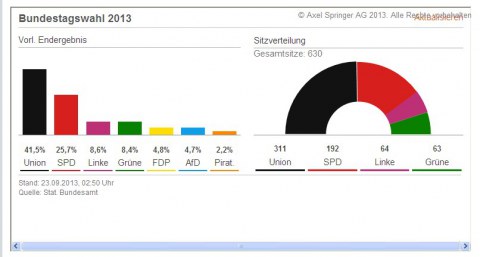
It delivered a triumph and most likely a third four-year tenure to Chancellor Angela Merkel. She has so far headed a three-party government comprising her Christian Democrats (CDU), a Bavarian counterpart, the Christian Social Union (CSU) and the pro-business Free Democrats (FDP).
That combination is over because the Free Democrats failed to get back into the parliament, the Bundestag, so Merkel is having to look for another partner to form government.
And there’s the rub.
Her options are The Social Democrats, The Greens or The Left.
Staunchly conservative she’s hardly likely to get into bed with The Left, and that aversion is mutual.
Not much different in respect of The Greens, who took a drubbing at the election but are still in parliament.
Leaves the Social Democrats. Some have lately described them as “CDU-lite” and there are some in their leadership who would coalesce with Merkel. But debate is raging for and against in Social Democrat rank and file. Some liken Merkel to a praying mantis devouring her partner live after mating.
If Merkel can’t get it together, there’s one other much discussed possibility which would have the numbers: a coalition of Social Democrats, Greens and The Left, red-red-green the short moniker for that.
The Left would be up for it, but so far the Social Democrats and The Greens are ruling it out – at leadership level, it has to be said. The rank and file may want it that way.
If I were a punter, my money would be on Grand Coalition with Merkel in the driving seat.
Like Der Spiegel says: the Germans and their hankering for consensus.
A new party all the others feared was the Alternative for Germany (AfD) which furiously opposes the gigantic Euro bailouts to keep floundering European countries like Greece afloat.
Other AfD policies are substantially right of centre.
They missed out on parliamentary seats by a whisker, scoring 4.7% of the votes when 5% are needed to get in. Had they got the 5% it would have been a completely different ball game.
Some sideline outcomes of the election made me glad.
Karamba Diaby, 51, a Senegalese by birth, won a seat through the party list of the Social Democrats, the first person from Africa to become a German MP.
Actor Charles M. Huber, 56, Munich-born out-of-wedlock son of a Senegalese diplomat and a German mother, won a seat for Merkel’s CDU through that party’s list. In the 90s he became the first black actor in a German TV series.
The number of Turkish heritage politicians in the Bundestag has doubled since the 2009 election. The Turkish community in Germany reports there are now 11. Three of them won their electorates outright.
Any bells ring for Australian readers of this?
Seats won in the 630-seat Bundestag: CDU/CSU 311, Social Democrats 192, The Left 64, The Greens 63.
For more go to http://www.spiegel.de/international/