

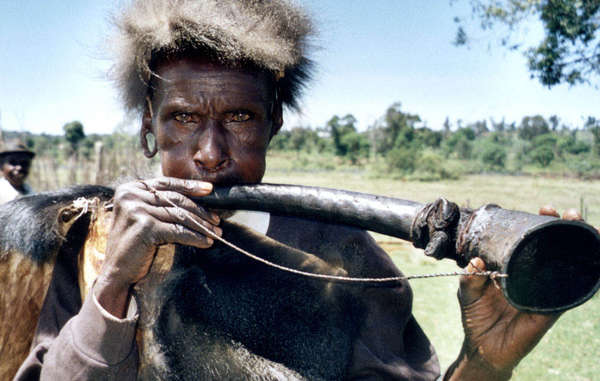
The Ogiek have seen much of their forest home destroyed by illegal settlers and loggers.
© Virginia Lulling/Survival
The African Court on Human and Peoples’ Rights ruled on 15 March that the government of Kenya must not evict the Ogiek from their land in the Mau Forest.
The ruling states that in the opinion of the African Court ‘there exists a situation of extreme gravity and urgency, as well as a risk of irreparable harm to the Ogiek Community with regard to violation of their rights guaranteed under the charter…’
The Court ordered the government to reinstate restrictions it had imposed on land transactions in the Mau forest, while it reaches a decision on issue.
The news was welcomed by the Ogiek, who have seen much of their forest home destroyed by illegal settlers and loggers. Joseph Sang an Ogiek spokesman told Survival, ‘It’s a sigh of relief yet again for indigenous peoples in the African context. We are all supportive of any move that will deliver justice to the Ogiek people.’
New ‘conservation’ measures threaten Kenya’s Ogiek tribe with eviction from their forest home.
The Ogiek are hunter-gatherers, and the Mau forest with its rich diversity of wildlife and forest produce such as wild honey, is vital for their livelihood and survival.
Joseph Lesingo, an Ogiek hunter told Survival ‘According to our history we are the indigenous people living in Mau forest. Without forest we cannot survive. We gather fruits from forest, we collect honey from the forest, and we hunt wild animals, and that is how we survive.
According to the Minority Rights Group, which with the Ogiek Peoples Development Programme (OPDP) and Centre for Minority Rights (CEMIRIDE) brought the case to the court, ‘This is the first time the African Court, in operation since 2006, has intervened to protect the rights of an indigenous community.
Read this online: http://www.survivalinternational.org/news/9061
Penan protest against pipeline, logging and dam
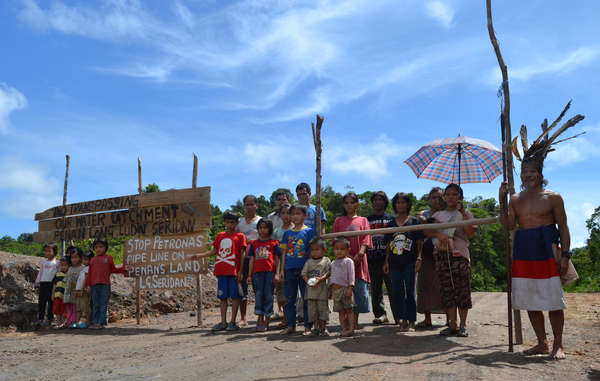
The Penan in Long Seridan are protesting against the building of a gas pipeline which is cutting through their ancestral land.
© Survival
Penan from the Long Seridan region have mounted a blockade to protest against the building of a gas pipeline which is cutting through their ancestral land and destroying their source of drinking water.
The 500km pipeline is being built by the Malaysian national oil company Petronas and is nearing completion. It will transport natural gas from the Malaysian state of Sabah, south to the coast of Sarawak.
The pipeline cuts through the forest of many Penan communities. It will make hunting and gathering even more difficult for the tribe, which is already facing grave hardship after years of logging have devastated their land.
The construction of the gas pipeline has affected many communities. One Penan man told Survival, ‘If they build this pipeline through our land it is a way of killing us. How are we to survive if they build this pipeline and we’re not able to move freely in our area – from one side to another?’
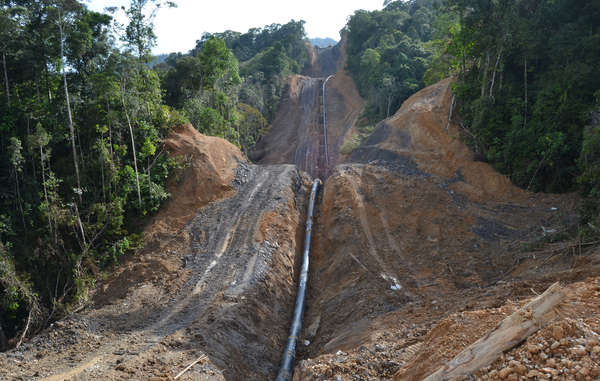
The 500km pipeline, built by the Malaysian national oil company Petronas, is cutting through the Penan's forest, making hunting difficult.
© Survival
The Penan in Long Seridan began their blockade against the pipeline almost three weeks ago and have vowed to continue until their concerns are met.
At the same time, another group of Penan from Long Daloh, more than 60 km away, have also been protesting against logging on their land and the Baram dam which threatens to flood their homes and the forest they rely on for their survival.
If it goes ahead, the Baram dam will displace approximately 20,000 tribal people. Many Penan, and other indigenous communities, have already protested against the Baram dam and called for it to be cancelled.
Read this online: http://www.survivalinternational.org/news/9053