
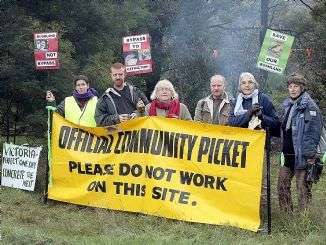
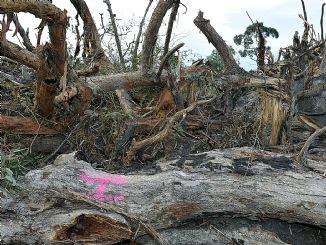
For over two months members of the “Friends of The Pines Flora and Fauna Reserve” have staffed a community picket to stop the bulldozers destroying an irreplaceable piece of Heritage listed indigenous vegetation at the Westerfield property on the Mornington Peninsula.
Four people have been arrested on the 28th September as bulldozers and police started to move in. Read the story here
The property is slated for destruction to make way for the environmentally destructive and unnecessary Peninsula Link Freeway that has been rammed through without any scrutiny under the “Major Transports Projects Faciliation Act” by the authoritarian Brumby government. Community members have bravely blocked the bulldozers on this site to prevent it going the way of other indigenous vegetation remnants around Frankston that have already been destroyed to make way for another carbon spewing freeway. Please consider donating to the campaign or even better attending the Community Picket which is staffed dawn to dusk each day. For more details of how to get there, news about the picket and about the campaign itself visit http://savethepines.net or call Gillian Collins on 0414 309 960, picket organiser and coordinator Friends of The Pines Flora and Fauna Reserve
Read about the first day of the picket
Read about the destruction of indigenous vegetation for the Freeway that started in May.
THE IMPACT OF THE FREEWAY
The Victorian State Government is currently bulldozing the Peninsula Link Freeway through the centre of Frankston’s 220 hectare Pines Flora and Fauna Reserve and a string of other irreplaceable wetlands and bushland remnants to its north and south. Brumby pre-empted the “Independent” Panel report reviewing the South and Eastern Integrated Transport Authority’s Environment Effect Statement thus wasting $5m of taxpayers money and thousands of hours of submitters time.
Beautiful landscapes supporting endangered species
The route through which the government plans to build the Frankston bypass is a critically important habitat corridor.
Government agencies, private and academic ecologists and consultants have testified to the outstanding values of the remnant bush and wetland ecosystems, and to their fragility in the face of ongoing degrading pressures and inadequate management and protection.
This is the closest place to Melbourne where the endangered Southern Brown Bandicoot and other endangered species survive in the wild. It’s also the closest place in Melbourne’s South and South East where Swamp Wallabies, Echidnas, Koalas and other iconic Australian species roam freely.
The largest areas such as the Pines Flora and Fauna Conservation Reserve are especially important because smaller areas are prone to degrading edge effects such as noise, light and nutrient overload, predator intrusion and weed invasion, which impact hundreds of metres into bush from surrounding cleared and urban land. Not only will the planned roadway destroy large areas of habitat, but destructive edge effects will dominate what remains.
A swathe from Carrum Downs to Langwarrin
The 20 odd kilometre swathe will cut south through the landscape from Carrum Downs to the Mornington Peninsula hinterland.
Among the many impacts of the freeway:
• An extraordinarily rare area of herb rich grassy wetland will be destroyed at Carrum Downs. The Department of Sustainability and Environment says it can’t be replaced.
• The road will destroy 60% of the Belvedere Reserve in Seaford.
• A huge stretch of heathlands, woodlands and swampy scrubland down the cenre of the Pines Flora & Fauna Reserve will be replaced by road, dividing the reserve and fauna populations and introducing ecologically debilitating noise pollution and other degrading effects.
• The bulk of Pobblebonk/Willow Reserve will be cleared and the water regime crucial to retaining the remainder will be changed destructively.
• The Wittenberg Reserve in Langwarrin will be decimated.
• A pristine and irreplaceable remnant of Herb-rich Grassy Woodland at the heritage listed Westerfield property will be cleared, along with waterbodies supporting the critically endangered Southern Pygmy Perch.
• Precious farmland the length of the Moorooduc Plain will be bisected.
• Remnants of bushland and scores of ancient high habitat-value hollow-bearing trees will be bulldozed.
• Fauna populations that will be impacted include sugar gliders, bandicoots, antechinus (a tiny relative of the Tasmanian Devil), eastern pygmy possums, echidna, brush and ring-tailed possums, swamp wallabys, eastern grey kangaroos, critically endangered southern pygmy perch, dwarf galaxia fish and several rareand threatened frog species.
• Impacted flora included dozens of orchid species.
The fight goes on.
Over the years the communities of Frankston and surrounds have fought for and protected these last remnants of the beautiful bush and wetlands which once cloaked the entire Mornington Peninsula.
Successive governments have allowed so much habitat to be cleared in and around Frankston that the retention and focused management of the few remaining remnants is crucial to the ongoing viability of fauna and flora.
The issue first came to media prominence in 1975 when a group of residents hoisted the Eureka flag and claimed the land for Frankston residents.
This land was recommended by Victorian bureaucrats in 1993 for reservation as a National Park. They also recommended that Vicroads give up the road reservation.
In 1995, Mark Birrel, the Minister for Conservation, advised Parliament that “This is the most botanically significant reserve in south-eastern Melbourne.” Mr. Birrel’s statement followed 20 years of public controversy regarding successive proposals to subdivide and quarry this land. The time has come to reclaim this land.
The Department of Environment and Sustainability acknowledges the destructiveness of the freeway & bypass proposal. In its submission to the Bypass & Freeway Environmental Impact Statement, the Department of Environment and Sustainability said “The potential impact of the proposed bypass may cause the local extinction of this species.” (Southern Brown Bandicoot)
This advice was repeated to the EES Panel by many experts including the Government’s ecological consultant.
Parks Victoria recognises its importance. Parks Victoria advise that two hundred and eighteen flora species recorded in the Reserve are considered to be regionally significant within the Gippsland Plain Bioregion. Land abutting the Reserve’s edge was the last place the Frankston Spider Orchid was found in the Peninsula’s north. Its numbers are now fewer than 40 plants in the wild.
There are alternatives
There are alternatives. If fly-over’s could be built over Burke, Toorak and Tooronga Roads, then so to can Cranbourne road be overpassed and the delays alleviated.
Comments
Re: Join the “Save the Pines” Community Picket
Keep fighting comrades. you have our support from the other side of the country. small battles like this are going on from east-to-west. see the campaign website: www.saveunderwood.org for some info about the community struggle to protect sacred remnant bushland in Perth, WA.
may strength and willpower be with you!!!!