
Gerry Georgatos
(Photo - October 2008 during a visit to Aboriginal Tent Embassy, Canberra)
A widely reported presentation was recently delivered by the Honourable Justice Wayne Martin – Western Australia's top judge – at the Curtin University Annual Ethics Lecture. The lecture was attended by various news media and was widely in the news the next day however most of the news media, social commentators and shock jocks jumped on it, some out of altruism, and skewed and bent Chief Justice Martin’s premises – most of it sadly that Aboriginal children, where it appears it should be the case, should be removed from their parents. The argument being if it is was non-Aboriginal children living in appalling conditions and perceivably neglected they would be removed, however the majorly premise that they are not being removed in many cases is presumably “a knee jerk over reaction to the fact of the Stolen Generation, and all the guilt associated with this.”
This was not the premise of the lecture Chief Justice Martin delivered however this is the premise that far too many social commentators and journalists have worked from and hence thumped scare mongering, prejudice and bias to their readers and listeners. They have attacked child protection policies as being too soft where it comes to Aboriginal families and imputed that more children should be removed.
Chief Justice Martin’s lecture was about reducing Aboriginal disadvantage rather than generating more broken families and lives. His lecture was entitled, “Bridging the gap, some ethical dilemmas.” He posed the question of whether a system that operates to the disadvantage of a group within our society can in all honesty be described as a fair and just system.
“At one level it is possible to respond to the problem by asserting that the justice system does not discriminate against Aboriginal people per se, but applies equally to all who have prior criminal records, a history of substance abuse, poor prospects of rehabilitation and so on. But that response seems to me to be facile,” said Chief Justice Martin.
“Conversely, a policy which involved sentencing Aboriginal offenders more leniently than non-Aboriginal offenders merely because of their Aboriginality would, in my view, be unjustifiable.”
The supposition of his argument was that the law is not fair and just where it is interpreted as maintaining a lesser value to Aboriginal victims of Aboriginal offenders, and the antecedent to the argument was that where this is the case that in fact it brings the rule of law into disrepute – there is no place within the law to allow lesser value to any group of people, be it in any form of deliberation, consideration and mitigation, and which will ensure suffering to the victims of offenders – in this case the exception argued is Aboriginal victims of Aboriginal offenders.
In a multifaceted argument of various constructs and bents Chief Justice Martin journeyed past imputations and hypotheses to propositions and said that the best way of protecting people is to protect the whole of community. The best way to reduce crime is to protect the community from crime, and in order to do this restoratively the underlying causes of offending behaviour need to be addressed. However in keeping to moral and legal parity and propriety and hence in terms of the underlying intentions of the rule of law as we know them it must be held true at all times that it does not matter whether the offenders and the victims are Aboriginal or not.
“So, if the over-representation of Aboriginal people in the criminal justice system is related to the multifaceted disadvantages which some Aboriginal people experience… - the focus of our attention should not be upon the Aboriginality of those offenders, but upon addressing the disadvantages to which they are subject,” said Chief Justice Martin.
His premise, in its Socratic cyclic manner, was not to scaremonger a need to remove children however to ethicize an urgency to address disadvantage and end vicious cycles. He said what any reasonably-minded person with an understanding of social democracy, who is listening to our unfolding human rights and social justice languages would say – in that we should maintain a whole of community approach, or where a child is at need because of the breakdown or appalling conditions a family lives within then to address the underlying causes, improve the health and living conditions, the educational levels and assist in ensuring participation in employment. By so doing this would reduce the effect of systemic disadvantage which is disproportionately high to Aboriginal people and which is the push factor leading them into and keeping them within the criminal justice system, and which unleashes effect upon family and community.
He posed several ethical conundrums, perceived paradoxes and assumptions, however they are not insurmountable and can be argued down as poorly constructed platitudes. He posed Aristotle’s argument about inequality and justice – “the worst form of inequality is to try to make unequal things equals.” However the answer is to remove inequality and not to make appear something into what is not possible. Inequality is not manifest from disadvantage – disadvantage is an effect, a consequence of inequality – inequality, like en masse poverty, is induced, it is supposed by conditions and apothegms, and legislators (such as in the Stolen Generations, in making Aboriginal peoples Wards of the State, in disenfranchising peoples of their rights) are responsible for whether we endure equality or not. Australians are still not effectively removed from the veils and layers of racism – from the origins-of-thinking which first generated the prejudices, biases and racisms and which subsequent generations, and from the highest offices of our nation shoved the bullshit down our throats. Aboriginal peoples are the only peoples in this nation who had been utterly disenfranchised from the right to accumulate education, health, equity and social wealth and hence who were denied the basic right, generation after generation, to leave the ensuing generation a little better off than their own.
“In the justice system, (Aristotle’s) concept is often expressed by observing that treating unlike cases alike is as great an injustice as treating like cases differently,” said Chief Justice Martin. In having been left with what we have, inequalities and disadvantage for all to see – third-world conditions in a first-world nation which is ranked second in the world, behind Norway, for social wealth and happiness by the United Nations Development Program Human Development Index, our justice systems must see people differently because of their circumstance, and hence there is mitigation, however from a criminological perspective this does not reduce offending nor the many victims of the offender.
“Because the dispossession and discriminatory treatment of Aboriginal people has resulted in the multifaceted disadvantages which I have identified, it could be argued that non-Aboriginal Australians have a moral and ethical obligation to treat Aboriginal people preferentially as a means of redressing the wrongs of the past. However, it seems to me to be unnecessary to go that far.”
News media reported that Western Australia’s top judge had questioned current child protection policies as an over-reaction to the Stolen Generation and that leaving children who could be removed and their lives bettered was resulting poorer standards of care and education for Aboriginal children. He said there was no doubt children were living in appalling conditions by agreement with Child Protection Agencies.
“The dilemma faced by the authorities is obvious. Do they separate the children from their family, with all the adverse consequences likely to flow from that course, or do they approve of children living in worse than third-world conditions?” posed Chief Justice Martin. He posed the premise of whether the State would approve of a non-Aboriginal child living in these conditions, and therefore whether the State was condoning Aboriginal children living in the poorest and most appalling of conditions – in homelessness for instance be it on the outskirts of mining towns such as is the case in the Kimberley, Pilbara, Gascoyne, Goldfields, such as is the case where Aboriginal families, young children and the elderly are sleeping under cardboard and corrugated iron at Ninga Mia on the outskirts of Kalgoorlie-Boulder.
“If that is the case, it raises not only a serious moral issue, but also the legal question of whether unlawful discrimination on the grounds of race is occurring,” he said.
He said that in the last ten years the Aboriginal prison population nationally had increased by 72 per cent to nearly 7700 while the rate of the non-Aboriginal prison population increased by 19 per cent. In Western Australia the prison population is 38 per cent Aboriginal. In the Northern Territory it is 84 per cent Aboriginal and NT Aboriginal peoples are imprisoned at five times the national rate. In one WA one in every twenty Aboriginal males is in prison.
He also pointed to a condoning by non-Aboriginal society of truancy by Aboriginal students and noted the “abysmal rate of truancy” at some regional schools, and said that these rates of truancy would not be tolerated if they were not Aboriginal students.
“Is our apparent acquiescence in lower attendance rates for Aboriginal children a form of structural discrimination which will doom those children to lower rates of participation in employment and more menial roles in society for the rest of their lives?”
He covered some ground in asserting that State and Federal Governments need to rise to the occasion and bridge the gap, financially – by committing what should be committed to addressing the myriad issues giving rise to Aboriginal disadvantage. However he also suggested that there needs to be greater collaboration between Aboriginal peoples and organisations focused first on what needs to be done rather than on secondary issues and personal advancement in reversing the increasing trend of over-representation within the criminal justice system.
In the end what needs to be done is simple – the full suite of funding, and on a needs-basis, to all Aboriginal communities and peoples so they can ensure the full suite of rights, natural, basic and other, and then ensure Aboriginal advancement by Aboriginal peoples and a cohesive multifaceted society. Where this has occurred Aboriginal peoples and communities have moved forward. This is the answer, there are no other solutions, and every other proposition is not just inadequate however therefore discriminatory and racist.
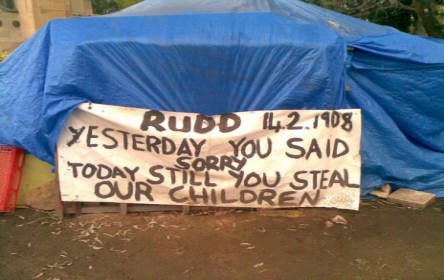
The Stolen Generations were heinously Stolen Children, not just a passage of time however of human life and dignity enslaved in one form or another, and emblazoned with a shameful legitimacy within the rule of law. There should be few reasons to remove children from their families, and not many. There should be little capacity to remove children and not an incredible latitude for this The reasons and rationales for the removal of the children between 1869 and into the 1970s has often been contested however it was with the sanction of parliamentary committees. The majorly reason provided by these committees was child protection, despite the motivators of social engineering which were self-evident. “Stolen” was first said by the Honourable P. McGarry, a NSW parliamentarian when he objected to the Aborigines Protection Amending Act 1915 which enabled the Aborigines Protection Board to remove the children from their parents without any need to have to establish that they were in any way neglected or mistreated. McGarry said this policy is akin to “stealing the child away from its parents.” Child Protection Agencies maintain enormous powers to this day without demarcated bodies to audit their judgements, and complaints mechanisms are internal, and the Children’s Court demonstrates an unbelievable investiture of faith and goodwill in the judgments and actions of Child Protection Agencies. When journalists and social commentators scaremonger the urgency for the removal of children or for tougher policies, these calls are too often subsequently supported by poll-driven parliamentarians and who too often come from backgrounds lacking expertise in the issues and without experience on the frontlines. In 1924, in the Adelaide Sun it was editorialised, “The word ‘Stole’ may sound a bit far-fetched but by the time we have told the story of the heart-broken Aboriginal mother we are sure the word will not be considered out of place.”
In the news media coverage on the lecture by Chief Justice Martin I have read and listened to I note that most commentators and journalists have highlighted the “neglect, abuse and despair.” They have described bleak lives and imputed that unless children are removed the hopelessness will continue with many of them facing a life within the criminal justice system. There is an assumption in most of the news media that Chief Justice Martin’s call for more to be done, in his push to address the underlying reasons for offending is fanciful – that the Governments will just not do this, and therefore the journalists, editorialists and social commentators are not even bothering discussing this and have dismissed this crucial element of the Martin lecture. They are taking some sort of skewed utilitarian approach in arguing that we should do what we can for as many of those affected as we can within the circumstances – let us help the most vulnerable at least, the children. This is not in some ways dissimilar to what some social commentators and parliamentarians argued one century ago in their bent to remove children from their Aboriginal parents so they could assimilate to better lives.
Social commentators in WA are calling for Child Protection Policies to stop considering the removal of a child and into the custody of the State as “as last resort.” The mantras of living a life in deprivation are being pushed, reminiscent of circa 1900. It is as if some people have never taken seriously the Stolen Generations and the volume of reports and affidavits of broken lives.
It is true that 68 per cent of juveniles in custody in WA are Aboriginal. Yet only 3.6 per cent of the population of WA is Aboriginal. WA has the highest imprisonment of its Aboriginal people in the nation, I have already noted that one in twenty WA Aboriginal males are in one of the 13 prisons.
How many more children do you remove? None – that is if I had my way, and I’d return most of the children who have been removed. Where we are soft is not on Child Protection Policies however in redress, in building equivalent communities, in creating the right conditions for all. It is easy however the will for this is not there, and it does not have to do with fiscal restraints, the financial capacity is there, and I have a very good understanding of Australia’s economy and its underwriting, however prioritising Aboriginal communities in the spend is not happening – and this has much to do with racism, the veils and layers of racism, paternalism, nescience and origins-of-thinking whose narrative should have been long done however which still permeates –endemically and perniciously.
Social commentators and journalists in their ignorance are arguing that the Stolen Generations were inexcusable and that children were removed without cause or reason – but in the minds of those then like those now they believed in various rationales – and similarly contemporaneously. The swathe of contemporary social commentators is blind to its own discrimination and once again oblivious to the devastating consequences. They have dissociated when they claim we need to put aside “fear and guilt” and that “sound child protection policies” are not about “blanket removals of children” but “rather about properly protecting the children.”
Chief Justice Martin pointed out children are being left in appalling conditions – it is the conditions we need to fix, not the children we need to continue taking away. He said we must the fix the conditions, help improve the lives of all the family members but the social commentators are carrying on “this is not realistic and it is long-term and expensive” and therefore children need to be removed otherwise they will finish up condemned to poverty and desperation, and a life of crime. They argue that in ten or twenty years the problems will be worse if the children are not removed and our Aboriginal prison population will double.
We need the social commentary to relocate itself to fixing the problems and helping families and communities and in being centred around equality.
Child Protection Authorities are being blasted for approving children to remain with their families while living in the most appalling conditions, however State and Federal Governments are not being slammed for not fixing the problems and in improving the conditions. In WA, more than 4,500 children have been removed from their families, more than half of them are Aboriginal – that is over 2,000 Aboriginal children. The Aboriginal population of WA is 80,000, therefore this is a horrific one in 40 Aboriginal people. That is also more than 15 per cent of all Aboriginal children in WA removed from their parents – this is catastrophic, and if this is the case nation-wide and there are parallels then it is a national disaster, shame and disgrace – and racism.
--- Gerry Georgatos - Journalist, Masters Social Justice Advocacy, Masters Human Rights Education, PhD Law researcher
LINKS:
The Lecture by Justice Wayne Martin:
http://www.supremecourt.wa.gov.au/_files/Curtin_University_Annual_Ethics...
http://www.theaustralian.com.au/national-affairs/was-top-judge-wayne-mar...
http://au.news.yahoo.com/thewest/a/-/newshome/14714431/judge-questions-c...
http://aap.newscentre.com.au/cpsunat/120901/library/victorian_public_ser...
He said the dilemma that confronted authorities was obvious and recent tragic events had re- inforced the dangers and risks associated with removing children from their parents. Justice Martin said the answer could lie in providing alternatives that focused on ensuring entire families lived in acceptable conditions, rather than just the child. Justice Martin said it had to be recognised that some improvements were being made and the vast majority of Aboriginal people were law-abiding citizens who contributed greatly to the nation. "Lessons can be learnt from the relatively short non-Aboriginal history of this place," he said. "However, we should not become frozen into inaction by our previous interventions, such as the Stolen Generations."
Comments
Bridging the Gaps between Family Law and Child Protection
http://www.aija.org.au/Child%20Protection%202011/Presentations/Jackson.pdf
In NSW
http://www.alsnswact.org.au/pages/care-and-protection
Today's problems stem from yesterday
http://www.aifs.gov.au/institute/pubs/fm1/fm35yw.html
Traditionally, the Aboriginal family was a collaboration of clans composed of mothers, fathers, uncles, aunties, brothers, sisters, cousins and so on. This size of family was the norm but is recognised in today's terms as an 'extended family'. Life prior to colonisation was straightforward, and love was abundant. The ways were easy but intelligent, slower but knowledgable and simple. It was a way of life that survived for hundreds of thousands of years, undisturbed and untouched.
Like all races and cultures we are not a homogenous group of people, but very different in many ways. However, each of us believes in our spirituality and our cause, we know of the genocidal acts experienced by our ancestors and of the problems faced by Aboriginal people in a white dominated society. Therefore, in dealing with the issues of the Aboriginal family, I can not put myself in the position of the voice of all Aboriginal people. My thoughts are individual and reflect my lifestyle, my learnings, my culture and my opinions, and although many other Aboriginal people around the country may relate to my words, mine is only one of many voices.
This paper focuses on family life with specific regard to racism (including damaging stereotypes), the effects of child removal, and the importance of the knowledge and wisdom of our elders. In order to understand present day struggles we have to look at historical factors, which have seen the transition of a rich and motivated lifestyle to a life of struggle against the injustices faced by our people. As stated in Vol.2 of the National Report of the Royal Commission into Aboriginal Deaths in Custody (p.3):
'It is important that we understand the legacy of Australia's history, as it helps to explain the deep sense of injustice felt by Aboriginal people, their disadvantaged status today, and their current attitudes towards non-Aboriginal people and society.'
Our problems are no different from those of 30 to 40 years ago, however the difference is that more of our people have become educated and have gained the confidence to fight the system.
Child homelessness
http://www.homelessnessaustralia.org.au/UserFiles/File/Fact%20sheets/Fac...
Homelessness and poverty should not be reasons
Gerry's articles on homelessness of Indigenous families should have been linked to this story
http://www.indymedia.org.au/2012/05/17/the-kimberleys-homelessness-rates...
http://www.nit.com.au/news/1204-barnetts-legacy-the-kimberleys-homeless-...
Horror figures reveal one in 10 people, largely Indigenous
and including women and children, are forced to live rough
"I wonder some day how Barnett will explain to his grandchildren that when he was Premier of Australia's wealthiest State, when he presided over a mining boom, the Aboriginal peoples of the Kimberley had the world's worst homeless rate and the highest suicide rates in Australia,"
http://ingetjetadros.com/2012/06/11/homelessness-in-australia/
Homelessness in Australia
It’s now almost 4 yrs ago i picked up my photography and while living in Broome i thought there was only one place to start documenting, something my heart went out too and i felt drawn to, which was the Aboriginal people. Even i’ve travelled all over the world and lived in Egypt i was shocked to see the conditions where the indigenous where living in. The alcohol problem is so bad that it wrecks peoples familes and lives. Overcrowded houses, lack of housing creates chaos. It basically wrecks their culture. They are lovely people and have the best sence of humour. Over the years i’ve made some nice friends and contacts and i try to make time out of my restuarant and visit them, in a ditch, in the mangroves, in a park or just sit with them on the steet. I am very happy Gerry Georgatos from the NIT contacted me as he wanted to make an article about the homeless, so this article is the result of that. Than that same week the local Broome Advertiser was running a story as well, so also there i could help out with an image.
The Kimberley has the highest rate of homelessness in Australia and just about all of this homelessness is Aboriginal folk.
Published article in the NIT The National Indigenous Times Newspaper
Raising the Alarm
Submitted by Anonymous (not verified) on Thu, 07/06/2012 - 4:44pm.
http://aap.newscentre.com.au/cpsunat/120531/library/human_rights/2864180...
Alarm over Kimberley homeless rate
Author: Jane Hammond
Publication: The West Australian (28,Wed 30 May 2012)
Housing crisis A community human rights group says homelessness in the Kimberley has reached alarming levels and estimates that as many as one in every 10 people is sleeping rough or couch surfing there every night. The Human Rights Alliance says up to 3000 people in the region, most of them Aboriginal, are homeless with an estimated 600 living in makeshift shelters on the fringes of towns, in marsh land or sand dunes. The group visited communities in the Kimberley and collected more than 300 questionnaires as part of a series of cluster surveys. Alliance convener Gerry Georgatos, said the situation for many Aboriginal people in the Kimberley was dire and the rates of homelessness were growing each year yet there had been nothing in State or Federal Budgets to address the issue. He called for urgent action to relieve the shortage of emergency accommodation and affordable housing in the region and said as a first step the State Government should commission its own review of homelessness there. Data from the 2006 ABS Census found the Kimberley had the highest rate of homelessness in the nation, with 638 homeless for every 10,000 people. That figure was nearly 10 times the State average and well above the second worst, the Northern Territory, with 248 per 10,000. Father Matt Digges from the Broome Catholic Diocese said his outreach centre had seen an increase in new people using its service in the past year and was struggling to meet demand for emergency relief. Shire of Broome deputy mayor Anne Poelina said anecdotal evidence suggested more people were sleeping rough in and around Broome and many Aboriginal families were living in severely overcrowded homes as they accommodated friends and relatives who had nowhere else to go. Housing minister Troy Buswell said 263 social housing units had been developed in the Kimberley since 2010, and a further 129 new homes and 307 refurbishments were scheduled for completion this year.
Families abandoned
http://www.nit.com.au/news/413-families-abandoned.html
Shelters turning more homeless families away
http://www.abc.net.au/news/2011-12-15/more-homeless-families-rejected-fr...
Stolen Generations
http://www.abc.net.au/news/2011-12-15/more-homeless-families-rejected-fr...
One of the darkest chapters of Australian history was the forced removal of Aboriginal children from their families. Children as young as babies were stolen from their families to be placed in girls and boys homes, foster families or missions. At the age of 18 they were ‘released’ into white society, often scarred for life by their experiences.
Today these Aboriginal people are collectively known as the ‘Stolen Generations’ because several generations were affected.
Many Aboriginal people are still searching for their fathers, mothers and siblings.
you were on mark with poverty as a cause
http://www.indymedia.org.au/2012/05/16/poverty-is-increasing-life-is-get...
the poor have few options
http://www.guardian.co.uk/education/2010/oct/29/children-poor-families-p...
but the government will not help, so then?
http://au.news.yahoo.com/thewest/a/-/news/12914586/agencies-move-to-stop...
Government agencies are teaming up in an effort to combat solvent abuse among young children in Meekatharra.
Officials from Child Protection, WA Police, Corrective Services, Education, Health and the Drug and Alcohol Office this week launched a Volatile Substance Misuse Action Plan for the town.
Department for Child Protection director general Terry Murphy said the process would begin on February 29.
Fears of a rise in solvent abuse among neglected children in Meekatharra were raised by staff of an independent safe house centre which suspended operations on February 4.
Shadow minister for child protection Sue Ellery said DCP needed to do more to stop children roaming the streets at night.
Last week police aired concerns to DCP of two children who were abusing solvents, believed to be glue.
The children are understood to have been fl own to Perth on a commercial plane for treatment and remain in the department’s care.
Mr Murphy said the action plan would focus on prevention, intervention, law enforcement, treatment and support services. One local, said in last week’s Mid West Times, a group of 10 children aged six to 16 were known to have regularly sniffed solvents such as petrol, paint and glue.
Mr Murphy said the department was aware of a “small group” sniffing solvents.
“The Department for Child Protection believes that a small group of children and young people are affected by substance abuse and some of these young people are part of a transient population that stops over in Meekatharra,” he said.
Meekatharra Shire president Tom Hutchinson believed the issue was comparable with any other community.
“It’s no bigger a problem here than anywhere else,” he said.
“But because we’re a small town, people are more aware of it.”
Cr Hutchinson said the Shire invested about $500,000 each year on youth services and programs at the community centre.
“The Shire is working to give children things to do to keep them off the streets,” he said.
“But we can’t take care of them at night. That should be up to the parents, that’s the bottom line of it.”
stealing away of everyone's rights
You are right Gerry, taking children away from their families is to the stealing away of everyone's rights