
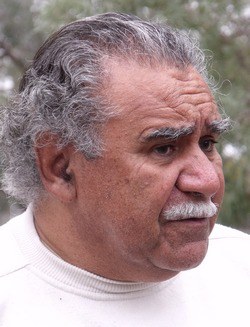
Goodooga, northwest NSW, 21 September 2012 - - Deferment of constitutional change means politicians of all stripes and their “negative Aboriginal collaborators” must now face the truth and back calls for negotiating a treaty, writes sovereignty campaigner, Michael Ghillar Anderson.
He sees an opportunity “to focus on the real issues and not band-aid programs and objectives that serve to soothe rather than deal with the hard matters that Australia has to face up to”.
In a media release Mr Anderson, the last survivor of the four men who set up the Aboriginal embassy in Canberra in 1972, writes: “I wonder who in the Labor government saw the light and gave the advice that the majority of the Aboriginal people were working up a campaign to say ‘Vote NO’ to the proposed constitutional changes.”
The Euahlayi leader criticises Professor Patrick Dodson and other Aboriginal advisers to the government as “gutless”. “This is why they are sought after by both sides of politics.”
“It is sad that Professor Dodson and his conservative colleagues choose to give advice on what ‘all’ Aboriginals want as a future. They know full well that they do not have the authority to make such outrageous claims.” It is well-known that Professor Dodson has always campaigned against any suggestions of continuing Aboriginal sovereignty, Mr. Anderson observes.
Mr Anderson writes: “What is disturbing in all discussion about altering the constitution is not just meaningless recognition, but the fact that the politicians seek to keep within it a clause that permits any political party in government to maintain the constitutional and legal right to make laws permitting discrimination based on race. Moreover, section 25 of the existing constitution also allows for any race to be banned from voting in a general election for government.”
Mr Anderson’s release in full:
Having deferred a constitutional change, the federal Labor government and the Liberal coalition opposition must now take this opportunity to focus on the real issues and not band-aid programs and objectives that serve to soothe rather than deal with the hard matters that Australia has to face up to. The continuing sovereignty of the Aboriginal and Torres Strait Island nations and peoples must now be the blueprint for change. Constitutional reform to merely have our people referred to as the first peoples of this land is without any spirit or purpose, just an appeasement and a conscious numbing exercise.
Professor Pat Dodson and his cohorts are gutless in their advice to governments; this is why they are sought after by both sides of politics. More to the point, one needs to ask how come these type of people are seen as the only Aboriginal people with a master plan for our peoples.
I wonder who in the Labor government saw the light and gave the advice that the majority of the Aboriginal people were working up a campaign to say ‘Vote NO’ to the proposed constitutional changes.
Professor Dodson cannot legitimately argue that the Aboriginal people were truly consulted on this matter. Moreover, it is a well-known fact that Professor Dodson has always campaigned against any suggestions of continuing Aboriginal sovereignty. In fact Professor Dodson is on parliamentary Hansard in 1983, where he stated categorically that he is not in support of arguing for Aboriginal sovereignty and argued that ‘land rights’ was the real and only issue, then he and his collaborators gave us ‘native title’.
Given that this is indeed Professor Dodson’s position, it goes without saying that he disqualifies himself from giving any advice to governments, no matter what their political persuasions are. In fact, now that we know what Professor Dodson’s position is, he should now publicly state what his visions are for Aboriginal people across this country and then travel to speak with us personally about his vision or visions if there is more than one.
It is sad that Professor Dodson and his conservative colleagues choose to give advice on what ‘all’ Aboriginals want as a future. They know full well that they do not have the authority to make such outrageous claims. In fact the federal government and the opposition will be better off if they now turn their attention to the question of negotiating a treaty with Aboriginal people. Australia is an unsettled nation with a ‘black history’ that can no longer be ignored. Just as the High Court said in ‘Mabo’, Professor Dodson also acknowledges the fragility of the Australian statehood. During his interview with Sky News, he said words to the effect of “Australia is a fragile nation”.
What is disturbing in all discussion about altering the constitution is not just meaningless recognition, but the fact that the politicians seek to keep within it a clause that permits any political party in government to maintain the constitutional and legal right to make laws permitting discrimination based on race. Moreover, section 25 of the existing constitution also allows for any race to be banned from voting in a general election for government.
Are Australians so naive as to think that no political party will do it? History shows that this cannot be taken for granted. We have seen tyrants come to power arguing that they are looking after the ‘national interest’. Just listen to the daily radio talk back programs today. It is worrying to say the least.
Australia is a nation that cannot deal with its original inhabitants and the guilt that resides within this country hurts the invader society. The decision in Mabo created an opportunity to deal with the real issues, but instead the government and their frustrated chosen Aboriginal leaders continue to get it wrong.
Aboriginal people across this island continent just want the right to be who we are. We are people of many languages; clans; and we are attached to our country through our law. We are a people who have one Dreaming, connected through song lines that can be creased across the vast land mass. We are ‘NOT’ Australians, we are Yolngu, Gomeroi, Eora, Arnangu, Murrawurri, etc. Our rights come through our laws which are those of the ancient original inhabitants. There are no reasons for ‘special measures’. Our rights are inherent rights. The reason the invader society fails to deal with this is because they have nothing similar. The invader society is one that comes from a bastardised confused ‘mishmash’ of all sorts with little to no loyalty to a oneness. They create a mental picture of what they want to be and indoctrinate their children into their confused dream and when challenged use force and violence to get and or maintain what they create. Violence begets them as this is what their genetic inheritance tells them. This is their way of getting what they want. Just like the proverbial ‘brat’ child.
Aboriginal people across this country are now making their stand. We are a sovereign people and the invaders’ leadership and their negative Aboriginal collaborators must now face the truth and back our calls for a treaty to be negotiated.
¬¬¬
Mr Anderson can be contacted at 0427 292 492, ghillar29@gmail.com
For more on Aboriginal sovereignty see http://nationalunitygovernment.org/
Comments
More background
http://indymedia.org.au/2012/06/13/on-recognising-aboriginal-and-torres-...
Expert panel argued from lopsided, misogynist English law
Australia’s Constitution is a legal document.
In order to recognise Aboriginal and Torres Strait Islander peoples a legal document must recognise Aboriginal and Torres Strait Islander law.
Justice John von Doussain in the Federal Court, for instance, recognised customary foundation law with the view he was "not satisfied on the evidence before this Court that the applicants have established on the balance of probabilities that restricted women's knowledge as revealed to Dr Fergie and Professor Saunders was not part of genuine Aboriginal tradition". [Chapman v Luminis Pty Ltd (No 5) (21 August 2001):400]
The Australian government’s expert panel on the recognition of Aboriginal and Torres Strait Islander peoples in the Constitution made no attempt to recognise Aboriginal and Torres Strait Islander law, arguing, astonishingly, entirely from the perspective of the lopsided, misogynist law which washed up on these shores two centuries ago.
With a whitewash of ethnocentricity, the panel interpreted a problem with immigrant governance as a problem of Aboriginal and Torres Strait Islander assimilation into a crumbling tradition of subjugating women.
Panel member Professor Marcia Langton, when confronted with the evidence of an angry crowd urged on by intoxicated men at a meeting to discuss the matter in the hall at Maningrida, condemns the entire community without a scintilla of apparent comprehension of the traditional status of women, as unremarkable and unhelpful as her solution of substituting “first peoples” for “(first) race”.
Whereas, “It was ideas about ‘racial purity,’ ‘racial hygiene,’ ‘the master race,’ ‘the inferior races,’ a perverted idea about ‘the survival of the fittest’ and other such nonsense that led to the incarceration of Aboriginal people in reserves in the 19th century to prevent ‘mixing’ of the ‘races’ and later, the segregation laws that specified where and how ‘half castes’ and other ‘castes’ could live”, Professor Langton offers no appreciation these policies were the outcome of an entrenched imbalance of power between women and men, an absorption with male privilege the legacy of which is driving the current conversation about identity.
My dad attended Melbourne University in the 1930s, the seat of learning from which Professor Langton pontificates, when eugenics was de rigeur.
Had his Tasmanian Aboriginal ancestory be revealed he would have been treated as a freak and removed, treatment the Professor appears to condone for those dispossessed and facing a lifetime of incarceration.
A panel of conscriptees unfamiliar with either male privilege or women’s business is just one more instance in the long history of fraud being perpetrated against Aborigines and Torres Strait Islanders.
The only genuine solution to the recognition of Aboriginal and Islander peoples in the Constitution is an amendment to provide for a women’s legislature, an amendment in the interests of all Australians guaranteed to achieve overwhelming public support.
The only genuine solution is a women’s legislature
Australia’s Constitution is a legal document.
In order to recognise Aboriginal and Torres Strait Islander peoples a legal document must recognise Aboriginal and Torres Strait Islander law.
Justice John von Doussain in the Federal Court, for instance, recognised customary foundation law with the view he was "not satisfied on the evidence before this Court that the applicants have established on the balance of probabilities that restricted women's knowledge as revealed to Dr Fergie and Professor Saunders was not part of genuine Aboriginal tradition". [Chapman v Luminis Pty Ltd (No 5) (21 August 2001):400]
The Australian government’s expert panel on the recognition of Aboriginal and Torres Strait Islander peoples in the Constitution made no attempt to recognise Aboriginal and Torres Strait Islander law, arguing, astonishingly, entirely from the perspective of the lopsided, misogynist law which washed up on these shores two centuries ago.
With a whitewash of ethnocentricity, the panel interpreted a problem with immigrant governance as a problem of Aboriginal and Torres Strait Islander assimilation into a crumbling tradition of subjugating women.
Panel member Professor Marcia Langton, when confronted with the evidence of an angry crowd urged on by intoxicated men at a meeting to discuss the matter in the hall at Maningrida, condemns the entire community without a scintilla of apparent comprehension of the traditional status of women, as unremarkable and unhelpful as her solution of substituting “first peoples” for “(first) race”.
Whereas, “It was ideas about ‘racial purity,’ ‘racial hygiene,’ ‘the master race,’ ‘the inferior races,’ a perverted idea about ‘the survival of the fittest’ and other such nonsense that led to the incarceration of Aboriginal people in reserves in the 19th century to prevent ‘mixing’ of the ‘races’ and later, the segregation laws that specified where and how ‘half castes’ and other ‘castes’ could live”, Professor Langton offers no appreciation these policies were the outcome of an entrenched imbalance of power between women and men, an absorption with male privilege the legacy of which is driving the current conversation about identity.
My dad attended Melbourne University in the 1930s, the seat of learning from which Professor Langton pontificates, when eugenics was de rigeur.
Had his Tasmanian Aboriginal ancestory be revealed he would have been treated as a freak and removed, treatment the Professor appears to condone for those dispossessed and facing a lifetime of incarceration.
A panel of conscriptees unfamiliar with either male privilege or women’s business is just one more instance in the long history of fraud being perpetrated against Aborigines and Torres Strait Islanders.
The only genuine solution to the recognition of Aboriginal and Islander peoples in the Constitution is an amendment to provide for a women’s legislature, an amendment in the interests of all Australians guaranteed to achieve overwhelming public support.