
Gerry Georgatos Riyadh Al-Hakimi was brought to tears watching a small Iraqi child drag himself along the street. The stump of his right leg left a trail in the dust as he dragged his body inch by inch. It was 2003 and Riyadh would soon be on his way to Australia and to a university education; however he vowed to do something for the children of his war-torn homeland. Related: SBS Podcast: Wheelchairs for Iraqi children -- The West Australian newspaper - Helping Iraqi children who are victims of depleted uranium, landmines and war
Riyadh describes, "I watched as he dragged himself, leaving a pitiful trail in the dust. There are many of these trails in Iraqi towns. Like many thousands of other Iraqi children who have lost limbs during years of war in Iraq, there was nothing that could be done for the boy. Our country has been devastated by the war, and it takes every effort to find the strength to cope with each day.”
6,000 Iraqi children who will never be able to walk are without wheelchairs – similarly there are 50,000 adults in this predicament.
To 2009 over one million Iraqis had met violent deaths as a result of the 2003 invasion according to one British research group. Contextually, these numbers indict the invasion and occupation of Iraq with a degree of equivalency to Rwanda’s genocide – in 1994 the Rwanda genocide cost between 800,000 to 900,000 lives. The infamous Cambodian “Killing Fields” cost 1.7 million lives.
In August, Reuters from Baghdad reported “The number of civilians killed by violence in Iraq rose to 159 in July from 155 in June, matching January with the highest toll so far for 2011, according to health ministry figures.”
Reuters continued, “Violence has dropped sharply since the height of Iraq’s sectarian conflict in 2006-2007, but killings and attacks still happen almost daily... The number of Iraqi police killed declined to 56 in July from 77 in June, while 44 soldiers were killed in July in comparison to 39 killed in June, according to figures from interior and defence ministries... The ministries said 199 civilians, 135 police officers and 119 soldiers were wounded in July attacks... At least 28 people were killed and 58 wounded on July 5 when a car bomb and a roadside bomb blew up in a crowded parking lot outside a government building in the town of Taji, just north of Baghdad. The explosions hit police, government workers and Iraqis lining up for national identity cards.”
16 April 2009, The Independent reported, “Analysis carried out for the research group Iraq Body Count found that 39% of those killed in air raids by the US-led coalition were children and 46% were women. Fatalities caused by mortars, used by American and Iraqi government forces as well as insurgents, were 42% children and 44% women.”
The table below summarises some of the Iraqi casualty figures.
| Source | Iraqi Casualites | Time period |
| Iraq Family Health Survey | 151,000 deaths | March 2003 to June 2006 |
| Lancet Surveys of Iraq War casuaulties | 601,027 violent deaths out of 654,965 excess deaths | March 2003 to June 2006 |
| ORB Iraq War casualties | 1,033,000 deaths as a result of the conflict/td> | March 2003 to August 2007 |
| Associated Press | 110,600 deaths | March 2003 to April 2009 |
| Iraq Body Count | 103,536 — 113,125 civilian deaths as a result of the conflict. Over 150,726civilian and combatant deaths | March 2003 to October 2011 |
| Wikileaks classified Iraq War Logs | 109,032 deaths including 66,081 civilian deaths. | January 2004 to December 2009 |
Riyadh describes, "The years of sanctions have deeply affected Iraqi society and people have learned to survive individually and have lost the sense of community and caring for others."
"As a result of the 1991 Gulf War the province of Al Muthanna is littered with thousands of unexploded landmines and missiles." "There are many heartbreaking of disabled children in Iraq."
Article from The West Australian giving background to the appeal
Most children amputees in non-OECD (Organisation for Economic Co-operation and Development) countries are victim of wars, those evil scourges flourished by bullets, explosives, bombs, land mines and missiles. Reference: http://www.unicef.org/graca/mines.htm
 |
 |
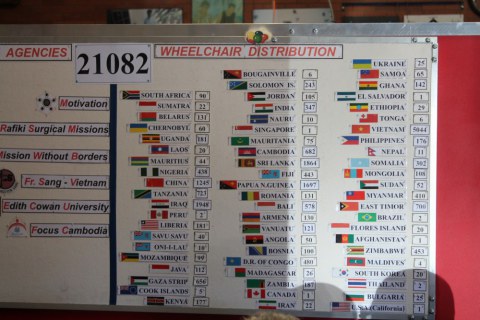
| Distribution by country of Wheelchairs by Wheelchairs4Kids | Some of the wheelchairs being distributed |
This last decade the Al Munthanna and Basra provinces of Iraq have challenged Angola for the highest proportion to total population of children amputees. Basra has been devastated by the war with most families having lost a family member, with many orphaned children and with most families caring for a family member who has been physically impaired. Let us not forget that Iraq’s Al Munthanna and Basra was laid victim to depleted uranium during the war and hence they have levels of cancers unheralded since Chernobyl. Al Munthanna province has been invaded by thereabouts thirty radioactive sites.
Firstly, through the Centre for Human Rights at Curtin University and hence through a tertiary student volunteer organisation which I founded in 2005, Students Without Borders, I met Curtin University student and Iraqi Riyadh Al-Hakimi. Riyadh described to me much of the devastation of Basra and its effect on its humanity. I do not forget Riyadh’s description to me of a little Iraqi child dragging himself across the street in their hometown, and his withered deadened-like stump of his right leg creating a painful trail in the dusty street. There was nowhere to turn to find a readily available wheelchair nor could the parent afford to have one imported. Much of Iraq’s infrastructure had been devastated by the drawn out war. Life had been further complicated by the vehement acrimony between Sunnis and Shi’ites. Riyadh often described to me an Iraq, before the invasion, where it did not matter whether someone was Sunni or Shi’ite, and marriage and business between Sunnis and Shi’ites occurred on a daily basis. I will never forget what Riyadh once said to me, "Till this war was started on us in Iraq, no-one ever asked me whether I am Sunni or Shi’ite. Never."
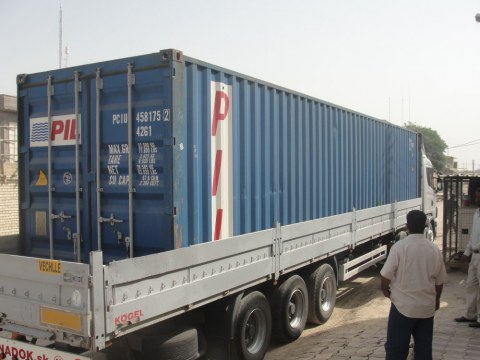
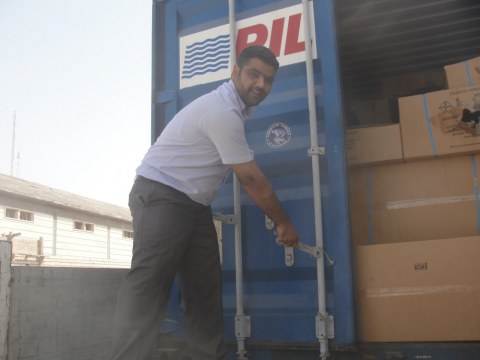
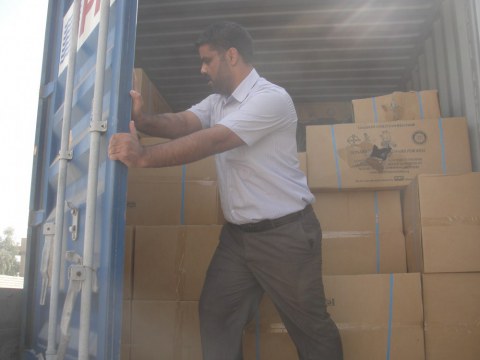
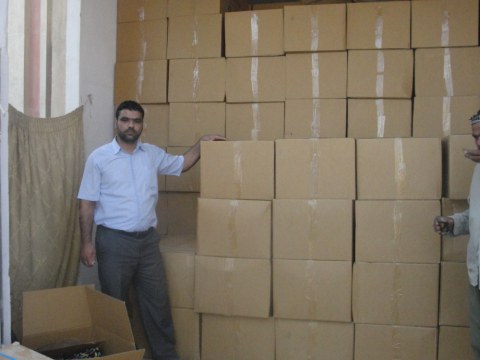
Riyadh and I teamed up through Students Without Borders to send as many wheelchairs as we could to the Iraqi towns of Najaf, Samawa and Ramadi. During 2008 we had planned on securing 200 wheelchairs however Riyadh secured 327 new children wheelchairs generously donated by Gnangara manufacturer Wheelchairs for Kids. However there began a long saga. No shipping company would transport the wheelchairs to the Basra port. It was deemed too dangerous. I had coordinated the shipping of many sea containers, usually full of recycled computers, to various parts of the world however it was the first time we were rejected by every shipping company. Woodside donated funds to cover their transport and Senator Chris Evans assisted by approaching the Australian Defence Forces. The staff of Wheelchairs for Kids gave of their time on a Saturday and packed them for transport. We organised transport to Sydney’s ADF Moorebank airbase, and from there they were flown to Kuwait. The ADF transported them by land, accompanied by Riyadh, and they disbursed them to the three towns of Ramadi, Najaf and Samawa. Najaf is Riyadh’s hometown and it has a high proportion of amputees. Najaf and Samawa are predominately Shi’ite and Ramadi is majorly Sunni. Riyadh wanted this gesture to bring the two peoples together as had been his world prior to the war. The local Sunni hospital in Ramadi distributed over 100 wheelchairs - and community did view Riyadh’s gesture as one of goodwill and every reason for reconciliation. It’s not all what some of the news media portray to its readers in that people are often irreparably divided - in the end all people have 'good’ in them and it is in the 'good’ we must tap into to unfold a human rights language and hence a civil and just society.
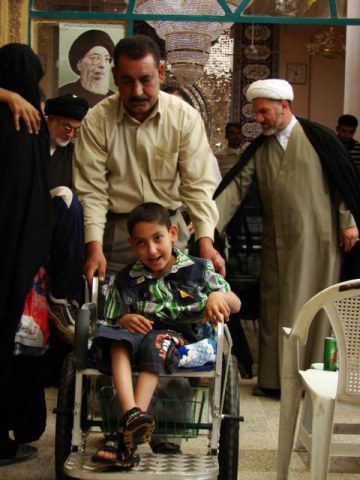
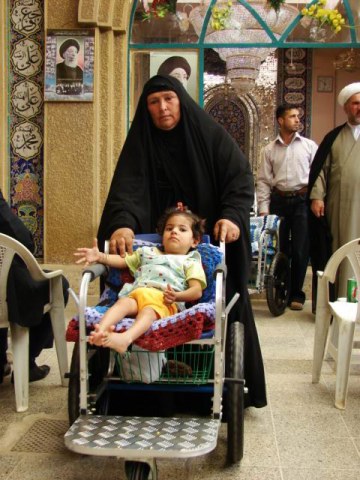
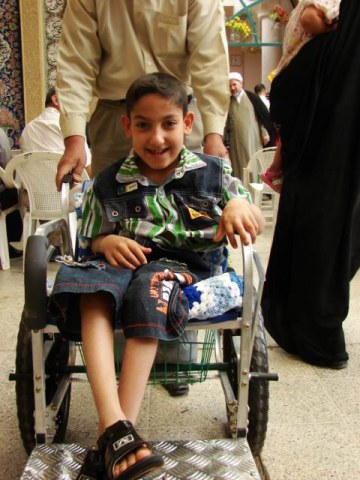
Photos from Iraq of Riyadh Al Hakimi with 330 childrens wheelchairs having arrived at Um Quasr port.
 |
 |
 |
 |
 |
Iraq’s infrastructure has been crippled and much of what has been blown away has not been replaced. People flee not only from persecution but also because they have no access to health or education nor any prospect for employment. If people better understood the UN Conventions in reference to Asylum Seekers they would realise that people have a right to life, liberty, security and the right to the protection and advancement of their families and their prospects. Despite the monthly loss of hundreds of lives by an unnatural hand in Iraq, Riyadh returned to Iraq to help his people, and describes an Iraq to me that is not as perilous as was a couple of years ago, that it is improving, however he describes an Iraq economically bare, and in desperate need of investment in basic services. He describes an Iraq where people are disempowered of hope from the devastating effects of the invasion, where people scratch around for daily needs and who keep their heads down having little to do with another, their community spirit diminished and disunited.
Riyadh and I are working through The Human Rights Alliance, which follows similarly in the steps of Students Without Borders. We are working to establishing a wheelchair assembly factory in the heart of Al Muthanna, in Samawa. Riyadh resides in Samawa, and he coordinates Students Without Borders Samara (University) and will be on hand to ensure the planning of the factory. Riyadh is a ‘political’ advisor to an Iraqi federal member of parliament from Al Munthanna. At this time we seek only for the wheelchairs to be assembled at the factory, so more can be shipped with each sea container or their parts bought cheaper than what is required for a pre-assembled whole unit. A sea container can carry three hundred and thirty whole unit wheelchairs however the same container can carry the disassembled parts for more than 1,000 wheelchairs. Riyadh has secured a block of land in Samawa for the factory – the land has been bought - and the people are waiting to be trained and employed. We have contacted Motivation UK, a charity who specialises in the provision of such pathways, to help us with the evaluation phase and to map out training and services. We are ensuring that the wheelchairs will comply with World Health Organisation guidelines so as to reduce toxaemia, bed sores, infections (which can lead to death). If we can secure some financial donors to help us underwrite a wheelchair factory where they can be assembled, and in the future manufactured from local resources, we will begin the journey for the demand for wheelchairs to be met. Subsequently, such a locally managed service will spawn other services required for maintenance and care. Obviously, we will generate much needed employment for some local Iraqis. Once we have children and adult amputees in wheelchairs produced from local resources, then prosthetics will arrive, localised prosthetic manufacturing and education institutes will be developed, and comprehensive basic health and medical services will be returned to the region to underwrite them. None of this is there at this time.
The assembly factory will be in the hands of Iraqis – this is the only way – people should not be at the discretion of philanthropy – Iraqi advancement by Iraqi people.
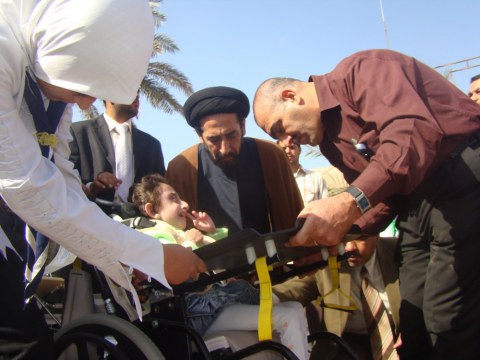
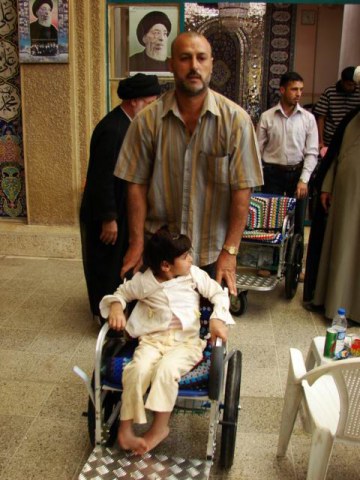
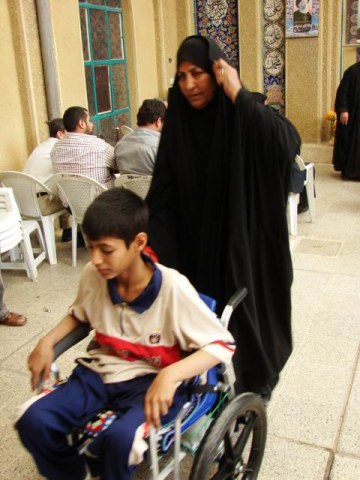
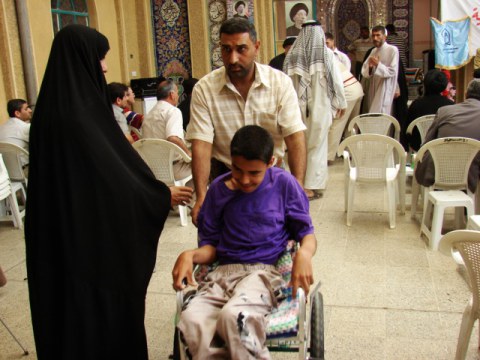
2007 - recipients of the first 300 wheelchairs to Iraqi victims - this load of childrens wheelchairs was distributed to children in the towns of Najaf, Samara and Ramadi.
 |
 |
 |
 |
 |
 |
To provide 6,000 children’s wheelchairs preassembled will take us 18 shipping containers and in turn years – we will continue doing this while we progress to the assembly factory – however once the factory is established then this will permit the wheelchairs to arrive in 6 shipments and we will be able to help the children hurt by this war who languish without wheelchairs. To me, it is always tragic that the US or Australian government does not just organise 6,000 children’s wheelchairs – they have certainly contributed an unnatural hand in the fact that these children are not able to walk.
Riyadh describes, "The idea of establishing a factory will contribute to strengthen community. The years of sanctions have deeply affected Iraqi society and people have learned to survive individually and have lost the sense of community and caring for each other. I have started working with university students and teach them to care for one another and not expect anything in return. It is important Iraqis run the project because it empowers them to do more for community and it makes them less reliant on foreign aid."
Iraq has a disproportionately high number of disability and amputees. For instance the radioactivity in Al Munthanna province, in Basra province, from the depleted uranium during the war, has led to a disproportionate number of babies born with deformities, and many who will never be able to walk. The landmines that still litter provinces kill and incapacitate adults and children, and children are especially vulnerable as many have been born after the first Gulf War. Al Munthanna, Iraq’s second largest province with a population in excess of 750,000, shares a border with Saudi Arabia, and as a result during the 1991 Gulf War became a battlefield and hence the unexploded landmines and missiles which are pocketed in the land they walk on. Foreign military forces will not traverse over certain areas they know too dangerous as a result unexploded landmines and or which are dangerously radioactive. During 2005 Dutch forces declared some Al Munthanna regions far too dangerous because of the radioactive levels and withdrew and on leaving warned the locals. Villages and schools surround these radioactive sites. However, the locals have not relocated - they have nowhere else to go.
Riyadh describes, "There are many heartbreaking stories of disabled children in Iraq. They place further burdens on families who struggle to feed their children. In Iraq disabled children are excluded from social activities as there is no infrastructure, and many disabled children will not let their parents carry them on their shoulders, being too embarrassed. Many have stopped going to school. In the street I live in there are six disabled children however only one of them was able to receive a wheelchair from the load we sent. Wheelchairs must be provided to every child that needs one in Iraq irrespective of their religion and ethnicity."
During 2008, the World Health Organisation released 'Guidelines on the provision of Manual Wheelchairs in less resourced settings' which now provide a standard of wheelchair provision in parts of the world lacking infrastructure and services that many of us in Australia take for granted. With the help of Motivation UK which specialises in wheelchair provision a flat-pack form of affordable, adjustable and durable chairs will be assembled by the locally trained staff at the factory and fitted, and adjusted and where necessary modified, to each user.
Iraq is not alone with a high proportion of amputees, and children are 20% of the amputees, however what we have now is the opportunity to give Iraqis in the Al Muthanna province, a region devastated by our Western World, reasons to believe in that their homeland can provide for them, that it can be everything that the United Nations Declaration of Human Rights describes in terms of the civil, human and economic rights necessary for dignity and adequate human worth. The predicament they find themselves in was in no way of their making, and it is fair to say that it is the making of the richest nations of this world.
If people wish to help they can contact me at gerry_georgatos@yahoo.com.au or call 0430 657 309. What we can do together governments will not – often in working with or for not-for-profits I have found that they know exactly what to do and do not need the advice of governments and rather that it is the governments and their authorities who need to be advised or led by the not-for-profits. The not-for-profit humanitarian organisations, whether they are there for our homeless, our refugees, our poorest, our war-torn, etc., they know the streets so to speak, and they listen one on one, governments and their authorities are far removed and the consequences of this are often the very disenfranchisement of peoples as witnessed by the not-for-profits.
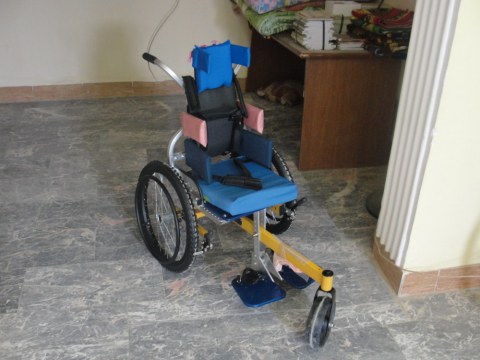
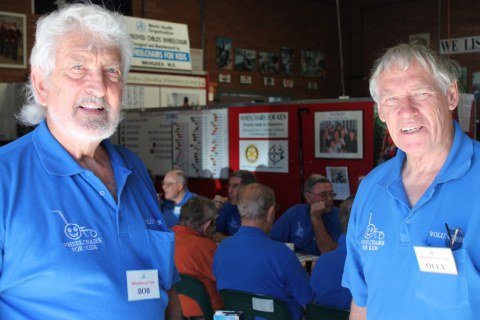
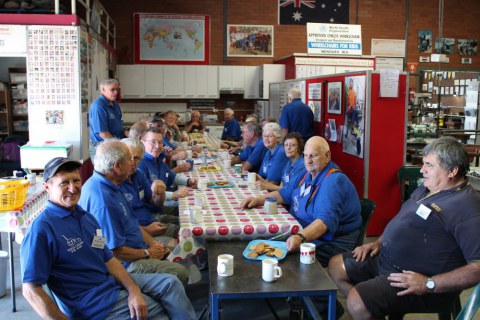
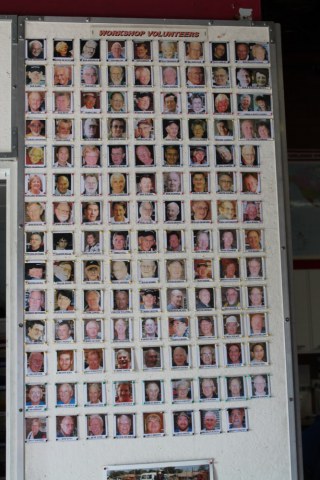
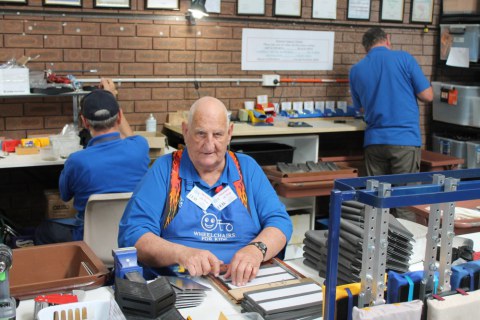
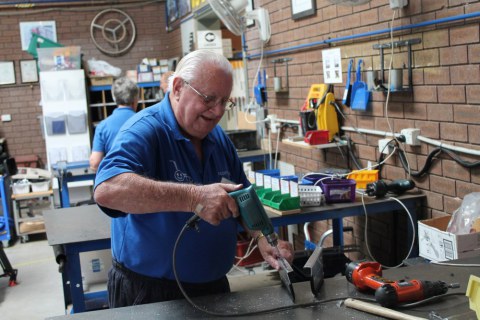
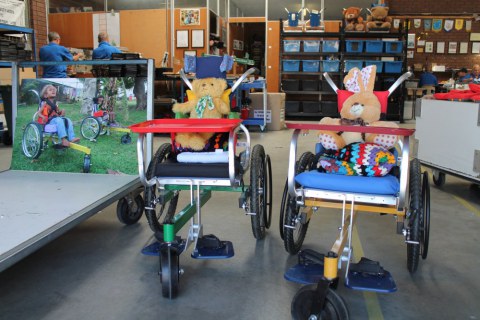
Wheelchairs For Kids will help us with another container load of children’s wheelchairs – 330 preassembled children’s wheelchairs which once again we a fund raising for the ridiculous amounts of monies to pay for the shipping container. WFKids is a Rotary based effort – based in Gnangara (northern Perth), the only donor of wheelchairs in Australia, and one of only two that I know of in the world. At this time each week 112 volunteers, retirees, give of their time in a great show of camaraderie, up to 30 on each daily shift, led by an inspirational chap, Brother Ollie Pickett – their volunteer workshop manager – in manufacturing the wheelchairs for children. Because of them more than 21,000 children’s wheelchairs have been donated during the last 13 years – to 61 countries.
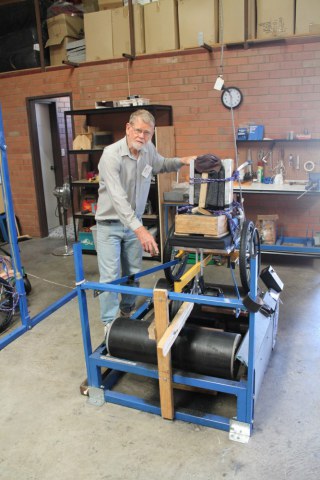
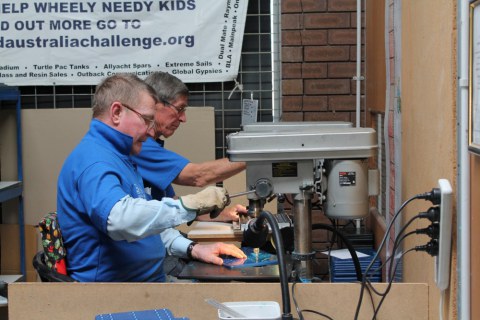
Some of the 112 volunteers work each week to manufacture children's wheelchairs for victims of war, landmines and depleted uranium at Wheelchairs for Kids
 |
 |
 |
 |
 |
 |
Some of Al Munthanna’s and Basra’s regions have been so devastated that they no longer share in bitumen roads and pathways and instead are gregarious pot holed roads, and dirt paths. These paths are not easily manageable by the fold up wheelchairs we send however at least the children afflicted by amputations and anomalies they were born with because of the depleted uranium, they are at least able to extend themselves from a confine within the home and an absolute dependency on others. The witness of a child amputee dragging his body across a road at least need not occur.
Related links
SBS Radio and Online news - Wheelchairs to Iraqi children - 330 wheelchairs arrive to Um Quasr
Country Bridgetown gets behind the Human Rights Alliance and children amputees in Iraq
The Students Without Borders website
Indymedia article on the predicament for Iraqi children and families
Comments
Inspirations you are.
Sad for the victims though.
I second what Beatrice wrote
I second what Beatrice wrote.
Re: IRAQ – landmines, bombs, depleted uranium – devastation ...
You are inspirational people for doing this
You are a good man Gerry
You are a good man Gerry
Evil Zionists fund these wars
"Till this war was started on us in Iraq, no-one ever asked me whether I am Sunni or Shi’ite. Never."Mission accomplished we went in there to divide and conquer we have divided the people they will now destroy each other Israel will be safe now.Some will say that this is a sick statement but that is what this is all about now we are expected to buy wheel chairs after we paid Millions to put them there, when will people wake up to the evil Zionists that fund these wars?We need to turn our Guns and bombs on the evil state of Israel then and only then can we think about peace in the world.Zionists run the Banks that finance these wars, Zionists run the Media that push for war like the weapons of mass destruction lie, and Zionists run America that carry out the act of war pushed by the Zionists.What will it take to make people to wake up and see we are all slaves to the Zionists?
Says something about what we think of Iraqis and their children
It's a bit sad that more haven't read this article and bypass it for other ones. Says something about what we think of Iraqis and their children? doesn't it? Good man you are Gerry to keep plugging away.
lets share this article around
I agree Anthony, lets share this article around then, Trevor
humanrightsalliance.org
humanrightsalliance.org
Re: IRAQ – landmines, bombs, depleted uranium – devastation ...
I encourage people to read the good work at http://humanrightsalliance.org/
Good on the people there
Anthony
Gerry wrote this on a HRA blog.
By Gerry:
There are many 'one good turns' in our world, we aren't shy of them, however many more, myriad bright, we could use to manage our way through our unfolding human rights language despite the fact when we look at the blight of wars and famines and various exploitations and ignorance we sometimes wonder at the tension and if in fact an unfolding human rights language will supersede various inhumanity.
Anyway, as we enjoy the festive season and its break from the hustle, there are millions who starve, billions in abject poverty and we recognise many try to do what they can to assist. There are also hundreds of thousands of children world wide, crippled by war, born with anomalies because of depleted uranium, and so on... Angola has the world's highest proportion of children amputees. The Congo and Afghanistan and Iraq challenge. The Human Rights Alliance (humanrightsalliance.org) in other words some caring souls under a banner, have worked hard to get children's wheelchairs to Iraq, we have sent over 1,000 of them, and there are still 6,000 Iraqi children without wheelchairs, who are confined to rubbled homes and who have to drag themselves to wherever they may realistically hope to get to. There is no wheelchair manufacturer left in Iraq - all blown away by a needless war - and hence we work alongside Wheelchairs for Kids, a Gnangara manufacturer, the only donor of wheelchairs in Australia, to get them to the kids - we raise between $5,000 to $10,000 for each shipping container load - 330 children's wheelchairs by us arrived in Um Quasr port, Basra for them to be distributed in time by Riyadh Al-Hakimi who I met at Curtin Uni and who has returned to Iraq to work for his people - and he has started a counterpart to us there - and he has distributed this latest load to Shi'ite and Sunni towns through hospitals to the children just before Christmas.
We do many things, work with the homeless on our streets, with those in crisis centres, donate computers recycled from verges! and tips and refurbish them and they've gone to many WA families, etc... and in we send these wheelchairs to Iraq, people can help by helping us... anyway, Wheelchairs for Kids, 112 retired folk who volunteer their time manufacture the wheelchairs, and 21,000 wheelchairs have been donated to 61 countries, and the HRA has donated 55,000 refurbished P4 computers, the largest such program ever in Australia, all from a small room by volunteers, 50,000 of them to WA folk, and the rest by containers to places around the world, for instance Uganda to provinces where schools got their first computer - a recycled computer that we may have collected from a verge or that would have finished up as rubbish tip, toxic litter and waste.
It'd be great for people to know they can help out sending a wheelchair or recycled computer or other service to someone in need - Most of us in Australia, 97% of us according to the UNDP Human Development Index (we are number 2 in the world as of November 2) have just about everything in terms of goods and services, public health and other opportunities that we need. We need not waste Christmas on us, rather better spent on others - it is about the what you can give - like in the spirit of the Little Drummer Boy.
In the Jakarta Post
http://www.thejakartapost.com/news/2011/12/24/letter-time-personal-refor...