
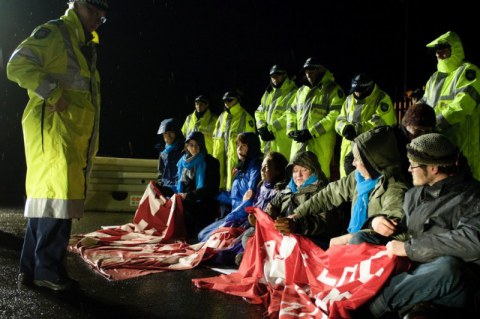
Peace activists have been arrested for the third consecutive day of the blockade of the Swan Island Military Base. A small but determined group of protestors were met by a large police presence, and two were arrested as the group attempted to keep the base closed. Photos of the picket
The convergence has been continuing all week as a protest against the unnecessary and ineffective war in Afghanistan, and to draw attention to the role that the top secret Swan Island base plays in the war. The war is now into its tenth year – as long than Australia’s involvement in Vietnam.
While the group protesting has been small, they are aware that they have the support of most Australians;
‘Poll after poll has indicated that the public do not support Australian lives being put on the line, with over 60% of Australians wanting troops to come home’ said co-organiser Jess Morrison. Ms Morrison also stated that ‘having been in Afghanistan, I have seen the devastating results of this conflict and I know personally the cost in innocent lives for the Afghan people, as well as the cost to Australian soldiers. This war has never made sense, and it is now time for the Australian government to listen to the people.’
The two protestors arrested this morning were Olivia Ball, a PhD student and parent of two from Clifton Hill, and Jessica Morrison, a University Lecturer from Fitzroy. Both were charged and then bailed to appear in the Geelong court later this month.
Other protestors remained, and continuing with singing, meditations and reading names of those who have died from both Australia and Afghanistan.
The Swan Island Peace Convergence will continue until Friday and plan to continue to blockade the base each day. More arrests are expected.
Findings old friends: Reflections on her arrest from Jessica Morrison
As with many people, my teenage years were framed with a handful of special friends that I journeyed through my turbulent adolescence with. Over the years I’ve lost touch with most of these friends and wonder how they’re doing. Facebook is giving me updates on their lives, but not a chance to reconnect.
Today I bumped into one of these teenage ‘besties’. Literally. He was on the police line facing me in our morning blockade. It was bizarre. I hadn’t seen him since I was a gangly girl, and he a bashful boy – crashing in our group in lounge rooms, and walking the streets in Geelong. And now here we were – me resisting the state, and he protecting it. Life had clearly taken us on different paths. I went up to him and had the reunion that I’d imagined happening in somewhat different circumstances. I confessed that I had a big crush on him when I was at high school (in hindsight a little unnecessary in front of his police colleagues). I remembered helping him carry his feret cage home from woodwork class in school; he remembered that I barrack for Collingwood (go pies!).
It was reminder of the shared humanity across the picket lines, which has been such a powerful feature of the week. There has been more mutual respect between ourselves and police than I have ever experienced in protests involving arrests. This however made it much more personal. It made me reflect about how I came to be who I was – from that gangly girl to a woman who seeks to blockade a military base. About what it was that led me to this place, and my friend to his.
So as with every morning I sung, talked about Afghanistan, and sat on the road. But this morning there was something different that was present for me. ………
After the usual three rounds of refusing to move from the road and being carried off, I was arrested. I took the familiar ride in the back of the police van and into custody. My solitary time waiting to be processed brought back more teenage memories, and how they were significant in forming my life’s perspective: My desire to help those who struggled in their life situations; the passion that my newfound Christian faith gave me to make a difference in the world; my jobs in social work that made me think in new ways about the social and political situations we are in; role models that challenged me to wonder how I can work towards peace and justice in the world.
I took bail and returned to the gates of the base to chat to my old friend. Sitting amidst the police trucks that were catering for the 180 police that are here to police us, we shared more about our lives – work, family, siblings.
We choose different places to be, and sometimes that places us in conflict with each other. And amidst this, we all stand together here in our humanity.
Comments
Whats the solution?????
If we pull out of Afghanistan would that mean that the Taleban would gain control of some regions? and would that mean you have no problem with the treatment of women under Taleban rule such as no education for women and what do you think the solution is?Have you really thought through what would happen if we pull out now?I agree many innocent people have died in this war and this has made a lot of Afghans embrace the Taleban but do we walk away and let the Taleban take control?I can think of no solution to this problem but I do know if we walk away now, we have turned our back on the women of Afghanistan is this what we want?
I would love to hear your views on a solution to this problem
The position of women in Afghanistan
Jarrod - you ask a great question to which there is not a simple answer. Unfortunately it is very true that the women of Afghanistan face much hardship. UN statistics show the women of Afghanistan to have some of the poorest education and health outcomes in the world. However it is also true to say that it is ludicrous to suggest that the U.S., Australia and its allies has committed ten years of military spending and lives in the cause of Afghan feminism. We are clearly there to boost the geopolitical power of the U.S. in a strategic region of the world. This is borne out by the fact that after ten years of occupation the situation of women in Afghanistan is still dire, including in many areas of Afghanistan not controlled by the Taliban. It is also true to say that the long cultural and political struggle that is needed to win women's rights in Afghanistan cannot be achieved by Predator drones, air strikes and night raids. It will need to be done over many years by grass roots organisations working on the ground to improve womens education and health outcomes. This will be a very hard struggle in a poor country wracked by thirty years of conflict but their is no shortcut via military means.
A vocal proponent of this view in Afghanistan (although there is obviously a diveristy of views amongst the Afghan people themselves) comes from rebel female MP Malai Joya - check out her views at http://www.malalaijoya.com/dcmj/
To confirm the view that this bloody war is not about female rights - you only need to consider the fact that the U.S. is now openly admitting it is negotiating with elements of the Taliban. This is in addition to the fact that some very rigorous anti-women laws have been passed by the Karzai Government and that many of the warlords in power now in Afghanistan have a record as appalling as the Taliban on female rights.
War and violence will not bring as a more peaceful just world, in Afghanistan or anywhere else.
Re: Swan Island Peace Convergence Day 4: Third day of ...
Malalai Joya is doing a speaking tour of Australia from August 28th - 11th September. For details go to http://www.sawa-australia.org/events.html I recommend that anyone who thinks we shouldn't pull our troops out of Afghanistan because the women will suffer should take the time to hear her speak!