
By Diet Simon and Klaus Schenck
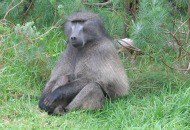
On South African industrial pine and eucalyptus plantations 400 baboons have been killed so far this year, almost 2,000 in the past two years, although the worldwide Forest Stewardship Council has certified the plantations as ecologically managed and socially responsible.
FSC describes itself as an independent, non-governmental, not-for-profit organization established to promote the responsible management of the world’s forests.
A formal complaint has been made to the FSC demanding that it withdraw its approval of the plantations in question, so far to no avail.
Despite being listed as a “threatened” species under the Convention for International Trade in Endangered Species (CITES, Appendix II), baboons are offered no protection under the law in South Africa.
The natural baboon diet comprises fruits, leaves, grasses, seeds, roots, insects and small vertebrate animals. They don’t find this balanced nutrition in the monocultures, so they bite off the pine bark to lick the resin for trace elements.
Hundreds are shot dead by the timber companies, predominantly Komatiland und York Timber. Licenses have been issued to kill a further 1,040.
The companies claim that the bark biting damages the trees. Scientific studies in South Africa and neighbouring Zimbabwe prove that the baboon killing is cruel and ineffective.
The baboons are not the problem, the industrial monocultures are. In South Africa the FSC-certified plantations already comprise 1.3 million hectares. Original ecosystems were destroyed for pines and eucalypts.
The animals lost their habitats and people also had to give up their land for endless rows of industrial trees.
These do not fulfil the important ecological and social functions of forests. Not just biodiversity dies, soils also degrade. Pines and eucalypts destroy the humus layer. That destroys the water balance and climate change is heated by the exuded carbon dioxide. These tree varieties are extremely fire-prone and frequently huge swathes of plantations burn, often killing dozens of people.
Local people and environment activists, including the South African organisation GeaSphere, have protested against the industrial plantations for many years.
Despite this, the international office of the FSC, based in Bonn, Germany, has certified the monocultures as “responsibly managed”, including 187,000 hectares owned by Komatiland and 94,000 hectares owned by York Timbers. A large proportion is located in Mpumalanga province.
By certifying the industrial plantations and tolerating the killing of baboons the green FSC label deceives customers. A large proportion of the FSC-labelled wood goes into the timber, paper and cellulose industries and is exported.
Activists have researched that the FSC certification is often fraudulently used in timber harvesting, for example in tropical rainforests and old growth forests in Scandinavia.
You might like to write your protest to
• the FSC International Center, Executive Director, Mr Andre de Freitas, Charles de Gaulle Str. 5, D-53113 Bonn, Germany, a.freitas@fsc.org,
• the Australian section of the FSC,
and
• the South African High Commission in Canberra.
Or you could add your signature to ready-to-go letters here.
For examples of how the FSC label hides destruction of old growth forest in Australia click here.
Comments
Illegal slaughter and trade in baboon meat
http://www.google.com.au/webhp?hl=en&tab=nw#hl=en&source=hp&biw=1276&bih...